Contents
- Should you size up or down?
- Does the chart measure your body or the finished garment?
- What if your measurements point to different sizes?
- Which fit points need to feel comfortable?
- Does stretch mean you should choose a smaller size?
- How can you separate size from length?
- Which movements should you test before keeping it?
- Could an alteration solve the problem?
- When should you try another cut instead?
- Can Vestly choose your size from a photo?
- Frequently asked questions
- Sources
This guide covers everyday clothing, rather than medical garments, protective equipment or technical underwear. Use it when two chart columns seem possible, or when your bust and hips point to different ones. You do not need to change your body to settle that disagreement. The garment may simply have proportions that do not work for you, even if its label looks familiar.
Should you size up or down?
Choose according to the garment and how you will wear it, rather than automatically sizing up. Two items with the same label can have close or roomy cuts. Buying an oversized top smaller to remove every bit of volume may change the intended shape. Going larger can add hip room while moving the shoulder position or pockets away from where you want them.
The Nike women’s tops guide includes advice based on the fit you prefer between sizes. That is guidance from one brand for a particular product group. It does not establish how rigid jeans or a lined jacket will behave. Keep your preferred amount of room in mind, but do not let that preference override a strained closure or uncomfortable movement.
| Situation | What it tells you | Next step |
|---|---|---|
| Both sizes feel comfortable | You may have a genuine fit preference | Compare with your intended outfit |
| One pulls and the other is loose elsewhere | The cut may not match your proportions | Try another cut |
| The chart does not define its measurements | The comparison remains uncertain | Ask whether it measures the body or garment |
| Only the length is wrong | Size and length may be separate choices | Look for another length, then ask about alterations |
Does the chart measure your body or the finished garment?
A body measurement and a garment dimension describe different things. A waist circumference goes around your body; a flat waistband width measures the item itself. Doubling that width does not turn it into a sizing recommendation. Waistband shape, elastic, construction and the measuring method can still affect the comparison. Find out what the seller’s column actually describes before using any of its numbers.
The Patagonia women’s charts identify their numbers as body measurements and direct you to product information for some lengths. Read the heading and notes before looking for the nearest number. If your measurement is old or the tape followed a different path, use our guide to taking clothing measurementsfirst, then return here to make your choice.
What if your measurements point to different sizes?
Check each area the cut needs to accommodate. On a fitted shirt, pay particular attention to the bust and shoulders. On pants, also consider the waist, hips and crotch position. The product’s instructions come first. A dress that fits your bust but restricts your hips does not become suitable because an average of those two measurements resembles a number somewhere in its size chart.
Do not convert a body-shape letter into a clothing size. A, V, H, X, 8 and O are styling shorthand for discussing proportions, rather than a way to assign a retail number to someone. Our guide to find your body shape explains the difference. The tool below asks a narrower question: does one measurement fall inside the ranges you entered? It calculates neither an ideal body nor a standard amount of ease.
Compare two body-measurement ranges
Copy one measurement location from the item’s chart, using the same unit. Boundaries are included. The result does not choose a size.
Fictional example and method without JavaScript
A measurement of 98 cm belongs to both 94–98 cm and 98–102 cm. These are invented ranges, not a brand chart. Compare your measurement with each option’s minimum and maximum; equality at a boundary is included. Repeat for other relevant measurement locations.
Values stay on this page during your visit: nothing is sent or automatically saved.
 Read alsoA-shaped body: how to dress to balance your silhouette
Which fit points need to feel comfortable?
Identify the area meant to sit close to your body, then look at the fastened garment in your normal posture. A lowered shoulder seam may be intentional on a dropped-shoulder design. A crease can come from posture or fabric. Use those clues to ask a better question and compare options, rather than treating one photograph as a definite diagnosis that an item is too small or too large.
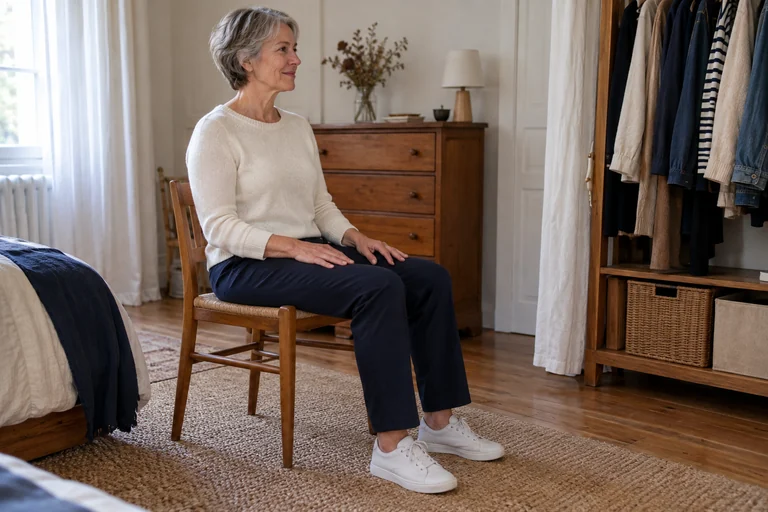
For jeans, the rise and leg shape also affect how the garment feels. Two designs associated with the same hip measurement may feel different when you sit down. Our guide to choosing jeans for your body shape helps you explore the cuts. Here, keep the decision practical: fasten the item normally, sit and move without needing to hold an artificial posture to make it work.

Does stretch mean you should choose a smaller size?
Stretch is something to check on the actual garment, rather than permission to tolerate discomfort. Fiber content alone does not describe stretch in every direction, the lining, seams or how the item holds its shape during wear. Do not turn an elastane percentage into a size recommendation. Read the specific product information and ask what the brand recommends when you fall between its sizes for that item.
The English video by Justine Leconte demonstrates fit checks on a women’s shirt. Use it to observe the shoulder area, buttons and movement, rather than to predict what another garment will do. It is not a test of your particular item. Keep the useful question in mind: what feels wrong now, and what are you merely hoping will change after wearing it? An unconfirmed future change remains a gamble.
A visual example from Justine Leconte officiel to compare with the steps in this guide.
Video in English
How can you separate size from length?
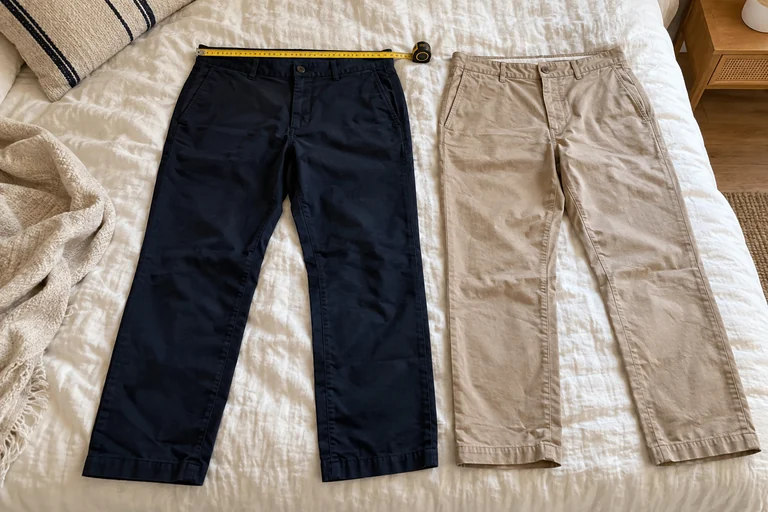
A hem that falls too low does not automatically mean the whole pair of pants is too large. First check whether the style comes in another inseam or proportion. A short or tall range may change more than the hem position, so read the description instead of assuming it only removes or adds fabric at the bottom. The goal is a suitable garment, rather than defending the first size you tried.
A comfortable item you already own can be a useful reference if you measure the same location in the same way. Lay it down without stretching it and keep the waistband’s natural shape. A flat garment measurement does not belong in the body-range tool above. You can share that dimension with the seller, clearly identified as a garment measurement, along with a specific question about the style you are considering.
Which movements should you test before keeping it?
Try the movements you will actually make in that clothing, without forcing anything or continuing through discomfort. Sit down, walk a few steps and reach for a nearby object. Try a jacket over the layer you intend to wear underneath. An item that works only while standing in front of a mirror may not work for a day spent sitting. Stop if a closure hurts or movement is uncomfortable.
Compare the two options under similar conditions: the same layer underneath, the same fastening and ordinary movements. Write down one observable point per area, such as “waistband comfortable when sitting, sleeves long.” Avoid “wrong body shape,” which tells you nothing useful about the garment. A short, concrete note helps you ask for another length or cut while remembering what already worked in the first option.
Check off
My six checks before deciding
0 / 6
Your checks are recorded. They do not guarantee a size.
Could an alteration solve the problem?
An alteration becomes an option after the person doing the work examines the garment. A simple hem, zipper, pocket and structured shoulder are different jobs. Available seam allowance and lining matter too. Do not buy something too small on the assumption that enough fabric will be available to let it out. A photograph alone is not a tailor’s agreement that the alteration can be done.
Ask what will change, what will remain visible, the price and the completion time before deciding. Check whether altering the item affects the seller’s return conditions. Do not assume the work is free or that an altered garment can still be returned. There is no universal percentage of the purchase price that makes an alteration worthwhile. Compare the actual quote with how useful the garment will be in your closet.
Flip cards
What should you ask the seller or tailor?
Unclear chartFlip
Ask whether the numbers are body measurements or finished garment dimensions.
Two possible columnsFlip
Give the item reference and affected areas, then ask for guidance specific to that style.
A length issueFlip
Ask which lengths are available and how they are measured.
A possible alterationFlip
Have the garment examined and ask what can be changed before paying.
When should you try another cut instead?
A different cut is a complete answer when each size merely moves the problem elsewhere. For example, the option that feels comfortable at your hips may have a loose waistband, while the other restricts movement. That does not prove a particular part of your body is a problem. Look for a different construction, a manufacturer-designed adjustment or another length range. Leaving the item behind is also a valid decision.
When shopping online, ask a question that calls for a verifiable detail: “Does this chart describe body measurements or the finished item?” or “Which dimension do you provide for this exact style?” A customer review can suggest what to check, but cannot guarantee your comfort. Ordering both sizes is not a required step. Read the actual conditions first, then decide whether that approach makes sense for you.
Quiz
Which decision uses useful information?
The chart only says “flat width.”
See the answer
I ask what the measurement describes before comparing. A garment dimension and a body measurement are not interchangeable.
The larger size is loose at the shoulders and the smaller one pulls at the bust.
See the answer
I can look for a different cut. Changing the style may solve a proportion mismatch without changing your body.
Stretch pants feel uncomfortable when you sit.
See the answer
I check the product guidance and do not rely on guaranteed stretching. Fiber percentages cannot predict your future comfort.
You like a jacket in a virtual try-on.
See the answer
I still check the actual garment’s measurements and comfort. An outfit visualization does not measure physical constraints inside the garment.
Can Vestly choose your size from a photo?
A virtual try-on shows an outfit idea; it does not measure waistband pressure or the space inside a sleeve. Vestly lets you bring your clothing together, build combinations and visualize looks using your photos. Those features can help you think about styling. They do not replace the exact item’s chart, measurements or a physical try-on that checks how the garment actually feels when you wear it.
You can explore Vestly to see whether a new piece works with the clothing you already own. To decide between clothing sizes, return to the practical facts afterward: the right kind of chart, product-specific guidance, normal fastening and comfortable movement. Keep the fit you prefer, ask for the missing detail or look for another cut. The number helps you choose an item; it does not define you.
Frequently asked questions
Should you always choose the larger size?
The product guidance and your comfort come first. A larger size may also move the shoulders or pockets. If each size creates a different problem, try another cut.
Will the same size fit across brands?
The label alone cannot tell you. Read the specific item’s chart and its measurement definitions, then check the cut and your movement.
Can you average your bust and hip measurements?
An average does not check both fit areas. Compare each relevant measurement with the product guidance; a restricted area still needs a solution.
Should stretch jeans feel tight when you buy them?
An elastic fiber does not guarantee future stretching. Check the specific product guidance and your comfort now, rather than tolerating pain in the hope it will disappear.
Does a flat width replace a body circumference?
They measure different things. Do not enter a garment width into a body-measurement column. Ask the seller about the method and chart type.
Does virtual try-on guarantee fit?
It helps you visualize a look. It does not measure pressure, freedom of movement or the stretch of the actual garment. Keep the chart checks and physical try-on.
Sources
- Nike: women’s tops chart and fit guidance
- Patagonia: body measurements and product details
- Damart: the brand’s advice between sizes
Sources checked October 21, 2026. The charts describe brand-specific guidance; none of the tool’s invented ranges comes from those charts.