Contents
You’ve probably noticed: some clothes make your complexion look bright and rested, while others make you look tired without you knowing why. Color analysis explains this. It looks at how colors worn close to your face interact with your complexion, eyes, and hair.
Popularized by the seasonal color method, color analysis is often done by image consultants using colored fabric swatches. But you can try its basic principles at home, by a window. Here’s how to identify your undertone and contrast level, then use what you learn to make practical choices.
The three criteria of color analysis
Undertone: warm or cool
Your undertone is the underlying hue of your skin, and it doesn’t change with a tan. Warm undertones lean golden, peachy, or olive; cool undertones lean pink or bluish. Some people have a neutral undertone, somewhere in between.
Intensity: bright or muted
Some people light up in pure, saturated colors; others look more harmonious in softened shades with a hint of gray or a powdery finish.
Contrast: high or low
Contrast compares the colors of your skin, hair, and eyes. Very dark hair against fair skin creates high contrast, which suits bold pairings like black and white. Low contrast pairs well with monochromatic looks and similar shades.
The undertone test to try at home
Do these tests without makeup, with your hair tied back or covered with a neutral towel if it’s colored. Asking someone else for their opinion can help, since it’s hard to judge your own complexion.
A visual example from Libby to compare with the steps in this guide.
Video in English
The four-season method
The best-known method groups the factors into four categories:
- Spring : warm undertone, light and bright colors. Coral, peach, apple green, turquoise, golden beige.
- Summer : cool undertone, soft and muted colors. Dusty pink, lavender blue, pearl gray, seafoam green.
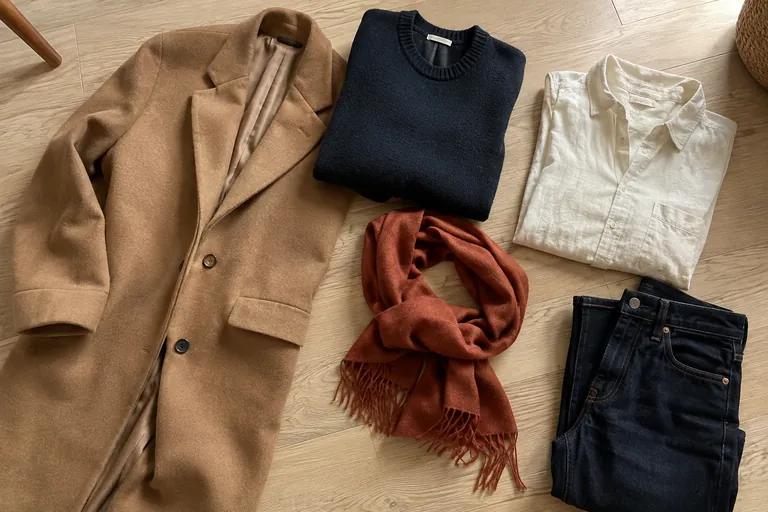
- Autumn : warm undertone, deep and muted colors. Terracotta, mustard, khaki, rust, camel.
- Winter : cool undertone, intense, high-contrast colors. Black, pure white, bright red, royal blue, emerald.
More detailed methods distinguish twelve seasons by combining these families. They allow for greater precision, but the four seasons are more than enough to get started.
How to use your colors every day
You don’t need to redo your entire wardrobe. Start with the pieces you wear close to your face: tops, scarves, collars, and jackets. That’s where color has the biggest effect on your complexion. Bottoms, shoes, and bags can be in less flattering colors without making a difference.
If you love a color that doesn’t suit you near your face, wear it on your bottom half, or put a flattering color between it and your face, like a scarf or shirt collar. To build harmonious outfits with your colors, our guide to pairing colors in your clothes has you covered.
 Read alsoWhat to Wear with Navy Blue: Color Pairings That Always Work
The limits of color analysis
Color analysis is a helpful tool, not an exact science. Results vary depending on the lighting, screens, and the eye of the person doing the analysis. It says nothing about your style, your taste, or what makes you happy. A color that’s “out of season” but that you love passionately can absolutely have a place in your wardrobe.
Use it as a way to understand why some pieces work better than others, then let your personal style make the call.
Frequently asked questions
Does color analysis change with age?
Your undertone stays mostly the same, but graying hair and changes in your skin affect contrast and intensity. Many people gravitate toward softer colors over the years.
Should you see a personal stylist?
It’s not essential, but a trained outside perspective, using real fabrics in good lighting, gives more precise results than testing on your own at home.
Does black suit everyone?
No. Black is most flattering on people with high-contrast coloring and cool undertones. For others, navy, charcoal gray, or chocolate brown can work just as well near the face.
Should you retake the test after coloring your hair?
Your skin’s undertone doesn’t change, but coloring your hair changes the contrast between your hair, skin, and eyes. Going from brunette to blonde, for example, may mean you can wear less contrast: your colors stay in the same family, but you may gravitate toward softer versions.
Does color analysis apply to makeup too?
Yes, the same principle applies: lipstick and blush that suit your warm or cool undertone naturally complement the clothing colors that look best on you. The right lipstick shade can even make a less flattering top more wearable.