Contents
- Separate support from style
- Check the belt loops with the belt on
- The narrow belt: a discreet detail to place just right
- The medium width: compare the flexibility and buckle
- The wide belt: leave room for the garment
- Use color to adjust how noticeable it is
- Check the length where you’ll wear it
- Try it for a full day before buying several styles
- How do you compare colors after checking belt width?
- Frequently asked questions
A belt can hold up pants, define a dress, or become the main detail of a look. Each use calls for a different choice. A beautiful wide belt may not fit through a pair of jeans; a narrow belt may disappear against a thick coat or create a crease in a soft knit.
To choose a belt width, start with the garment itself, check the loops if it has them, and try sitting down with the buckle fastened. Next, decide how much visual presence you want it to have. The width then becomes a response to your outfit, rather than a number chosen in isolation.
Separate support from style
If your first priority is keeping your pants in place, start by looking at the fit. The waistband should provide comfortable support without bunching up a lot of fabric. If it creates thick folds or pulls the zipper upward, the issue may be the cut. The guide to pants that gap at the waist can help you tell whether that’s the issue or you simply need an accessory.
If your main goal is to define a line on a dress or cardigan, the question changes. You can choose a more noticeable belt, soft or structured depending on the drape you want. Try it without tightening it further to “make the look work.” A comfortable belt should still let you breathe, sit, and move through your day. Judge how it feels after wearing it for a few minutes, not just while posing in front of the mirror.
Check the belt loops with the belt on
Measure or check the usable height of the belt loops, then try sliding the belt through without forcing it. The buckle, tip, and thickness can make it hard to pass through even if the strap seems narrow enough. A belt loop isn’t designed to stretch every time you use it. If you have to pull hard, choose a different width or style.
Also look at how the loops are spaced. A wide gap between two loops can let a soft belt move around more, while a rigid strap may lift at the back. Check the fit all the way around your pants and see how it sits with your top tucked in. The goal is for the accessory to work with the garment without putting strain on any one seam. So a belt that works with jeans won’t automatically be as practical with flowy pants.
The narrow belt: a discreet detail to place just right
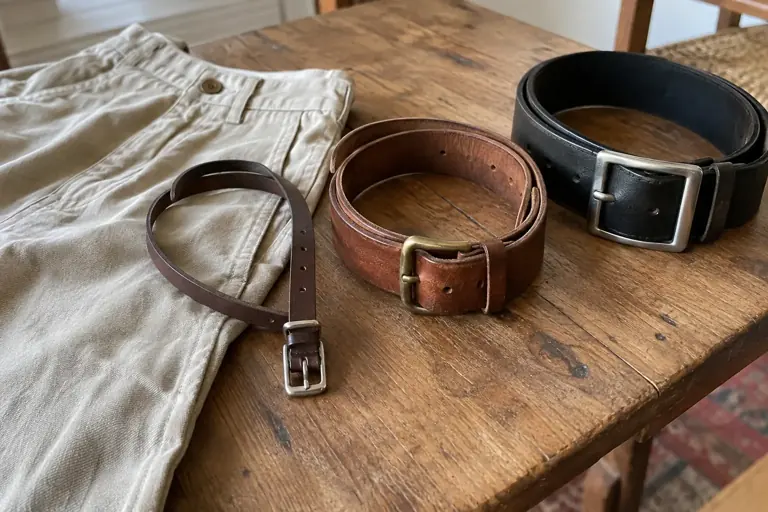
A thin belt can create a subtle division between your top and bottom or echo the color of a bag. It’s a good choice when you want the garment to stay in focus. With a lightweight dress, though, check whether it rolls, slips, or creates a very pronounced crease: a narrow belt concentrates the pressure visually and physically in a small area.
Try it at different heights without changing the rest of your outfit. Wearing it near your natural waist creates a different effect than wearing it on your hips. Keep the setting that feels comfortable and gives you a line you like. If the belt moves around a lot, look at the fabric of the garment and the length you chose. Adding a tighter hole isn’t always the best fix; a different shape or width may work better.
The medium width: compare the flexibility and buckle
A medium width is often easy to try with jeans or dress pants, as long as the belt loops can accommodate it. Still, two belts of the same width can wear very differently. One may be soft and follow your body; the other may be thicker and create a crisp line. Compare how they feel while sitting with the garment you plan to wear.
The buckle deserves as much attention as the strap. A bulky buckle draws the eye and may press into you when you bend over. A flatter buckle can stay discreet under a top, but its mechanism should still be easy to use. Test opening and closing it, and check how much length is left after adjusting it. An overly long end can get in the way if there’s no movable loop to hold it neatly in place.
 Read alsoFind your personal style in 5 steps
The wide belt: leave room for the garment
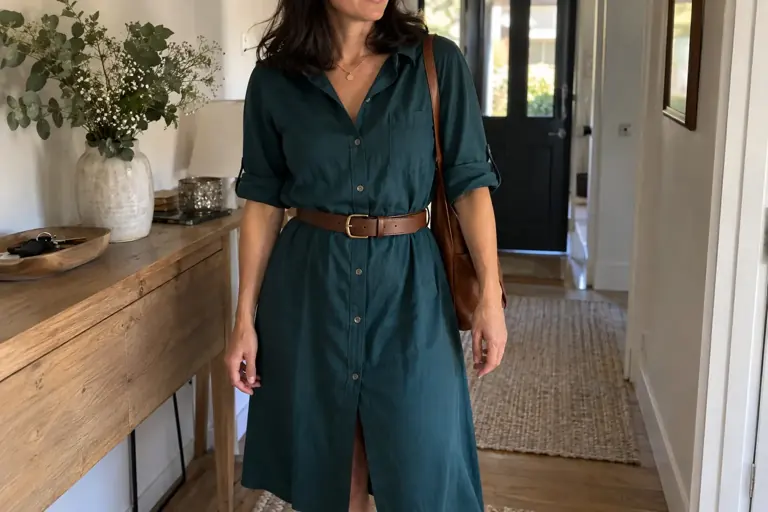
A wide belt usually becomes an important part of the outfit. Try it first with a dress or a fairly simple top so you can clearly see its effect. Check whether it lies flat, whether the edges fold over, and whether it feels comfortable when you sit. A stiff style may need a more shaped design than a simple straight band.
With knitwear, don’t tighten it so much that fabric bunches above and below. Gently smooth out the volume, then move around. With a jacket or coat, check that the closure, pockets, and layers underneath are still usable. If you have to remove the belt for every movement, save it for occasional wear or try a more flexible version. Our guide to dresses and their cuts can help you choose a base you already like without an accessory.
Use color to adjust how noticeable it is
A belt close in color to the garment creates a subtler transition. A contrasting shade draws more attention to the line where it sits. Before changing the width, try a different color: sometimes it’s mainly the contrast that feels too bold, while the shape works for you.
You can echo a shade in your shoes or bag without trying to match everything perfectly. Also compare the metal finish with the jewelry you’re already wearing. If the buckle stands out, simplifying another accessory can make the outfit feel more balanced. To build a look around one detail, find our method for putting together an outfit with your clothes. It helps you compare additions without turning the try-on into a pile-on.
Check the length where you’ll wear it
A belt worn at the waist over a dress and the same belt worn lower on pants may need different adjustments. Measure or try it on where you plan to wear it. Brands don’t all describe belt length the same way: check how they measure it instead of assuming the number refers to the entire strap or the distance to a specific hole.
If you’re shopping online, compare it with a belt that fits comfortably and note how it was measured. Also check the number of adjustment options, the closure, and whether the style can actually be shortened. Some designs are easy to adjust, while others need a professional. Avoid punching a makeshift hole with something that tears the edges; a clean alteration should preserve the material and spacing.
Try it for a full day before buying several styles
Wear the belt with the complete outfit, sit down, walk around, and pick up your bag. Check that it stays accessible and doesn’t keep rubbing against a closure or accessory. Then see whether the garment has kept the volume you wanted. This quick try-on helps you choose a belt you’ll actually wear, instead of an appealing style that’s hard to work into your wardrobe.
Keep a photo of the combination that works, and note the adjustment you need if you wear it with different garments. In Vestly, you can find the complete outfit and its details. Before buying a new width, try changing only the color, position, or base garment with a belt you already own. This comparison will show you what your wardrobe is really missing.
Quiz
What should you check first?
The belt barely fits through the loops. What should you do?
See the answer
Try a compatible style without forcing it over the seams. The belt, its thickness, and its tip should pass through easily.
A belt stands out too much in an outfit. What’s a useful thing to try?
See the answer
Try a less contrasting color before changing everything else. How visible the belt looks also depends on contrast and the buckle, not just its width.
Check off
My belt works with this outfit
0 / 5
You chose the accessory for how you’ll actually use it.
Once you have checked the loops and comfort, you can choose how to coordinate your belt and shoes. Compare a belt that echoes the pants with a more visible color before looking for another model; the guide does not require a new accessory.
How do you compare colors after checking belt width?
A visual example from Marie-Anne Lecoeur - The French Chic Expert to compare with the steps in this guide.
Video in English
Frequently asked questions
Does a wide belt only work with dresses?
No. It can also work with some jackets or pants, if their construction and belt loops allow it. Focus on comfort and how the fabric falls.
Do your belt and shoes have to match exactly?
You can match them, but a subtle echo in color or material may be enough. Consider your whole look rather than two accessories on their own.
Can you wear a belt over a cardigan?
Yes, if the knit and fit still feel comfortable. Avoid squeezing a soft fabric too tightly, and check that the cardigan keeps the volume you want when you move.