Contents
- Start with what you’ll look for later
- Check the contents before writing
- Choose the information that’s truly useful
- Place the label on the side that’s actually visible
- Use a label that’s easy to change
- Separate stored clothes from pending tasks
- Keep it linked to your inventory
- Update it when things change
- Frequently asked questions
A box marked “winter” might hold sweaters, accessories, or clothes you’d planned to repair. When all the boxes have almost the same label, you have to open them to find a single item. A useful label gives you just enough information to choose the right container without turning storage into a complicated catalog.
To label seasonal clothing boxes, start with the main category, then add a content cue and, if needed, the person or location it’s for. Keep the information easy to update. A short, current label is better than a detailed list that’s out of date after two moves.
Start with what you’ll look for later
Picture a specific search: finding a cardigan, a pair of gloves, or an outfit for a formal occasion. The word that comes naturally to you should appear on the label. “Warm knits” may be more useful than “box 3” if you don’t remember the numbers. On the other hand, a number can work if a clear list tells you what’s inside.
Choose words that everyone using the storage understands. If you share the closet, avoid abbreviations only one person knows. A simple, consistent category makes things easier to find. You can add details in a separate list, but the visible label should already help you tell the containers apart without having to interpret a system that’s too personal or complicated.
Check the contents before writing
Open the box and see what’s really inside. An old label may describe contents that have changed since last season. Use this step to separate clothes that are ready to store from those that still need care or repairs. Don’t close a box under a reassuring label if some of its contents still need attention.
You don’t need to inventory the whole house at once. Work one box or small area at a time, as in our method for taking inventory of your closet without taking everything out. Note what you’ve checked and leave the other containers for later. This distinction keeps you from assuming every label is reliable just because they all look the same.
Choose the information that’s truly useful
A label can include a main category and two or three details. For example: “Warm knits — cardigans and sweaters — bedroom.” If several people use similar boxes, a first name or agreed-upon label may help. If the contents change often, a review date can tell you when they were last checked without implying that it’s the clothes’ purchase date.
Avoid listing every color, size, and item count if you won’t keep it updated. You can put a complete list inside the box or in a separate inventory. The outside label should mainly answer the first question: is this the box to open? The right level of detail depends on how many containers you have and how often you use them.
Place the label on the side that’s actually visible
Place the box in its usual spot before choosing where to put the label. Under a bed, in a deep closet, or on a shelf, the accessible side isn’t always the same. A nice label on the lid isn’t much help if it stays hidden under another container.
If the box can be turned, you can add a marker to two sides, as long as you update both together. Keep the text large and high-contrast enough to read from where you’ll use it. Our guide to organizing a deep closet helps you think about access before you put things away. A label complements a good arrangement; it can’t make a container practical if it’s too heavy or stuck behind several stacks.
 Read alsoWomen’s capsule wardrobe: a list of essentials and how to choose yours
Use a label that’s easy to change
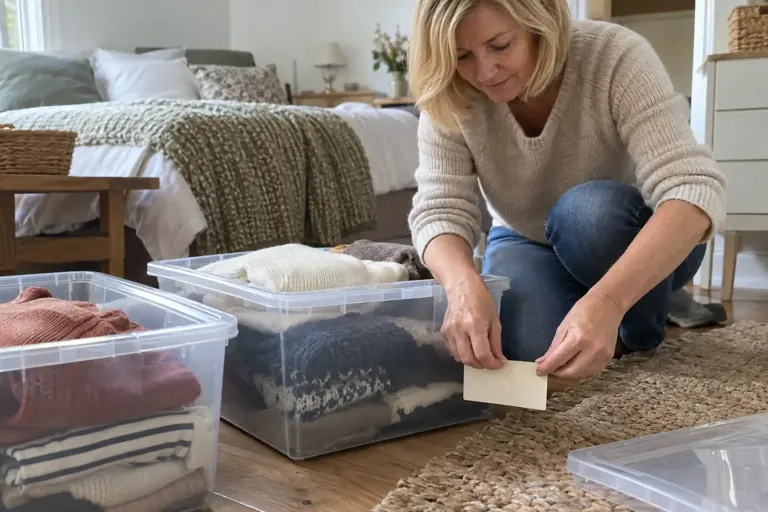
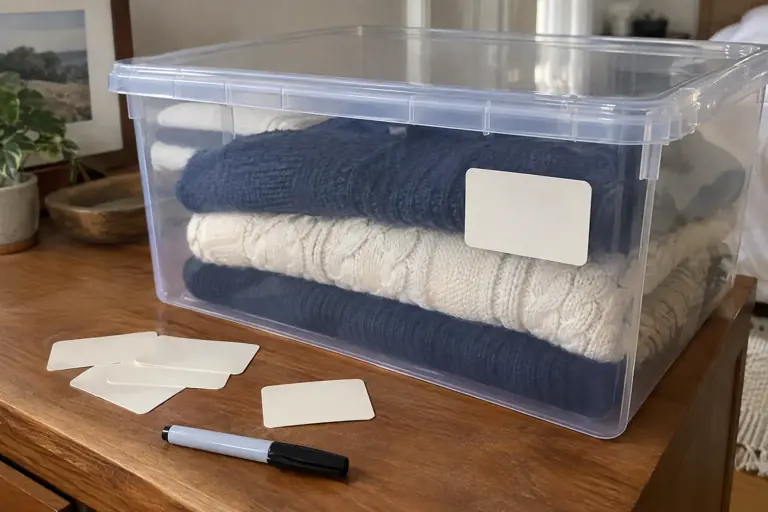
Choose a label option that works with the box and how often you’ll update it, such as a label holder, removable card, or suitable adhesive. Test it on an inconspicuous spot if you’re worried about leaving a mark. Avoid attaching anything directly to a delicate garment to identify it; keep the marker on the container or on a separate tag.
If the contents change every season, a replaceable card may be easier than permanent writing. If the category stays the same, you can keep the main title and change just one detail. Also consider how well the label will hold up as you handle the box: one that comes off the first time you move it quickly loses its usefulness. A practical choice matters more than a decorative material that’s hard to care for or replace.
Separate stored clothes from pending tasks
An off-season clothing box shouldn’t become an endless stash of pieces to repair, try on, or give away. If you have items in these categories, label them separately. That way, you’ll know which container needs attention and which holds clothes ready for their next wear.
Use specific labels like “to try on” or “button to repair” instead of a vague word like “miscellaneous.” You can add a short list inside with the next steps. Keep the system simple, though: one small holding area may be enough. The goal is to make decisions visible without multiplying boxes whose contents might be forgotten for several seasons.
Keep it linked to your inventory
If you keep a clothing list, use the same zone name or number on the box and in your inventory. This makes it easier to find a piece without having to record its location in a different way each time. When you move the box, update the relevant marker instead of leaving two conflicting details.
For a digital wardrobe, you can keep a personal record of the pieces stored out of season and where they are. In Vestly, clothing photos help you recognize what you already own; your physical setup should make those pieces easy to find afterward. The label is a link between the image or list and the actual storage spot, not a separate system that requires you to keep a second complete inventory.
Flip cards
Choose a more useful label
“Miscellaneous”Flip
Replace it with the main category or the action needed: winter accessories, pieces to try on, repairs pending.
“Winter” on four boxesFlip
Add the type of contents: knitwear, pants, accessories, or coats, depending on what’s actually inside.
A number with no associated listFlip
Add a short description or create an easy-to-find match.
An old, overly detailed listFlip
Check the contents, then keep only the information you’ll actually update.
Update it when things change
When you remove several items or add a new group of clothes, reread the label before closing the box. This small step saves you from a major update later. If the main heading no longer matches the contents, change it right away instead of relying on your memory.
At the change of season, start with the boxes you need, check their contents, and update the labels. Our guide to organizing your closet then helps you put everyday clothes back where they belong. You’ll have a clearer storage system, with off-season boxes that are easy to identify and pending tasks kept separate from pieces that are ready to wear.
Check off
My label will be useful later
0 / 5
The box can be stored with a reliable label that’s easy to find.
Watch a practical example
A visual example from Matt Baier to compare with the steps in this guide.
Video in English
Frequently asked questions
Should you write the exact number of clothes?
Only if that number helps you and you keep it up to date. A clear category may be more reliable than a precise count that quickly becomes outdated.
Can label colors replace text?
They can add another visual cue, but a readable word helps other people and saves you from having to memorize a whole color code.
Where should you put the detailed contents list?
Inside the box or in a linked inventory, if you’ll actually use one. The outside label can stay short and mainly help identify the right container.