Contents
- Start with one statement piece
- With a crew neck, create intentional separation between the lines
- With a V-neck, check where the pendant falls
- With a shirt, choose your jewelry before fastening the last buttons
- With a high neck, check the surface and friction
- Match the scale to the fabric and occasion
- Mix metals with a clear starting point
- Check the clasps and put away the pairing that works
- Frequently asked questions
A necklace can look beautiful on its own, then land right on the edge of a collar once you put it on. It disappears under the fabric, slips out of place, or catches on a knit. Choosing gets easier when you try the jewelry with the garment instead of deciding by looking at your jewelry box alone.
To pair your jewelry with a neckline, first look for a clear place for it to sit: above the edge, clearly on the garment, or in the opening. Then check how it moves, its weight, and where it touches the fabric. The right length is the one that keeps the look you want through your everyday movements.
Start with one statement piece
Start with what you feel like showing off: a necklace, a pair of earrings, or a detail in your outfit. Try that piece on its own, then add the others one at a time. This way, you can see what really adds something instead of automatically piling on all the jewelry you wore the day before.
Look at your outfit from a normal distance from the mirror, then move closer. A small pendant reads differently from a wide necklace, especially on a printed fabric. If the neckline already has a bow, ruffles, or embroidery, compare a version with a necklace and another with just earrings. The guide to putting an outfit together follows the same principle of building around one chosen detail.
With a crew neck, create intentional separation between the lines
A short necklace can follow the line of a crew neck, but check that it stays visible and doesn’t get caught halfway under the edge. Adjust the clasp if you can. You might want a small gap between the neckline and the jewelry, or a length that rests clearly on the garment. The awkward spot is often somewhere in between, where it keeps shifting.
A longer pendant creates a different effect on a solid top. Check that it doesn’t hit a table when you lean forward and that the chain doesn’t pull at the back of your neck. On textured knitwear, inspect any small prongs, clasps, or embellishments that could catch. A very fine chain can look subtle while still needing extra care around a loose knit.
With a V-neck, check where the pendant falls
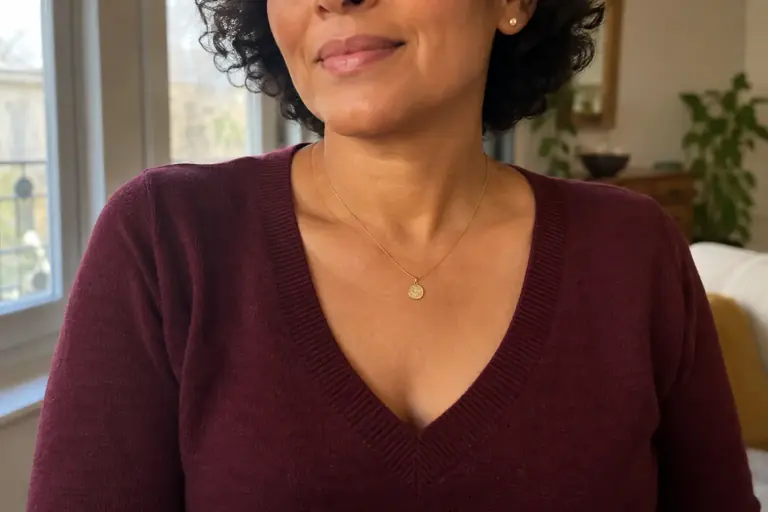
Try a pendant that sits within the neckline without constantly touching the garment’s edge. Compare its length while standing and sitting. A soft neckline may open up more as you move, while a closer-fitting top keeps a steady line. So choose jewelry with the garment you’ll actually wear, not just the advertised “V” shape.
You can also wear a shorter necklace that creates its own line above the V. This works if you like that mix of shapes. Pay close attention to whether the pieces stand apart clearly and whether you like the look with your planned hairstyle. If you’re adding long earrings, compare the look without a necklace to make sure each piece has room to shine.
With a shirt, choose your jewelry before fastening the last buttons
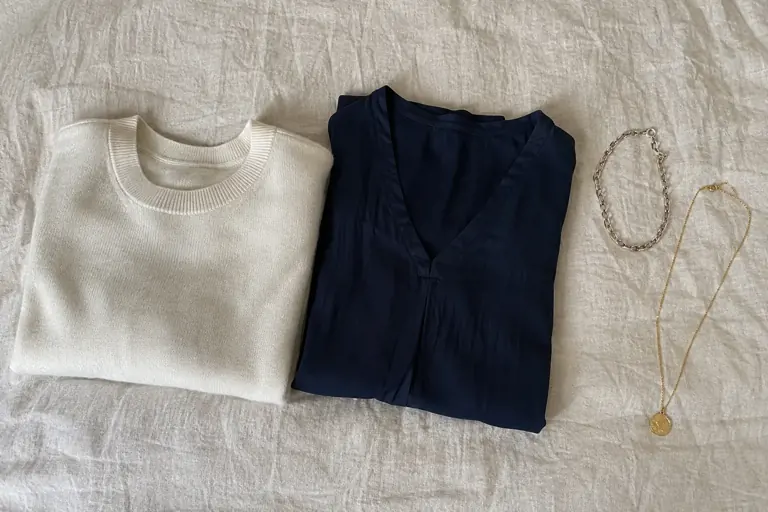
A shirt with a few buttons undone leaves room for a short necklace or pendant. First set the opening the way you plan to wear it, then add the jewelry. If it slips behind a collar point or catches on a button, try a different length instead of readjusting the collar all day.
A buttoned-up shirt can work with a necklace worn over it, but the fabric and construction matter. A thick placket, a very stiff collar, or a busy print may already make a strong statement. Compare a simple chain, a bolder piece, and no necklace. Our guide to wearing a white shirt offers combinations where you can try these three options.
 Read alsoFind your personal style in 5 steps
With a high neck, check the surface and friction
A high neckline offers an uninterrupted surface that can show off a necklace worn over it. Choose a length that sits clearly so the pendant doesn’t get caught in the neckline’s folds. Check the chain from the side and back: it shouldn’t catch on the fabric when you turn your head or put on a jacket.
Earrings can also be the main detail, especially if you prefer to keep the front of your top simple. Check how they meet the neckline. A long earring may hit a chunky knit, get caught in a scarf, or disappear into your hair. Move your head a few times and try on the outer layer you plan to wear; it’s a quick check that can help before a full day out.
Match the scale to the fabric and occasion
On a smooth, solid-colored top, a detailed piece of jewelry stands out easily. With a print, its details may blend into the pattern. That doesn’t mean a piece is “too beautiful” for everyday wear or that a print rules out accessories. Just look at what you can actually see once you have the whole outfit on.
Think about your plans, too: keyboard, headphones, phone, scarf, crossbody bag. A piece of jewelry that feels comfortable at dinner may become annoying when you’re typing for a long time or putting on headphones. For a casual chic, one well-chosen accessory is often enough to polish simple pieces. Choose a size that works with how you move, so you don’t have to plan your day around your accessory.
Mix metals with a clear starting point
If you already wear a watch or ring every day, use it as a guide. You can stick with the same metal or try a deliberate mix. Compare the size and finish: two delicate pieces look different from a chunky shiny chain paired with several matte pieces.
You don’t need to replace your jewelry to match your bag clasp and clothing buttons exactly. Instead, look at the details near your face, then take in the whole look. If it feels scattered, remove one piece and try again. This helps you see what was causing the confusion, while adding another matching detail may simply make the outfit feel busier.
Flip cards
Finding a place for your necklace
It falls halfway under the crew neckFlip
Compare a shorter setting or a length that rests clearly on top of the garment.
The pendant keeps touching the V-neck edgeFlip
Try a different length with the top worn as you normally wear it.
The chain catches on the knitFlip
Check the clasps and change the pairing instead of tugging to free it.
The neckline is already very detailedFlip
Try it with just the earrings to keep the garment’s detail in view.
Check the clasps and put away the pairing that works
Before you leave, check the clasp, the pendant’s direction, and the length you chose. Gently put on and take off your jacket or coat to see if the jewelry shifts. If a chain catches in the fabric, stop moving and free it carefully instead of tugging on both at once.
Take a photo of the complete outfit if you like the combination. In Vestly, seeing the pieces together again makes it easier to recreate the same proportions, even if you change an accessory. You might note the necklace length that worked with this top. One practical reminder can save you time next time you try it on, without turning every jewelry choice into a new search.
Check off
My jewelry works with this neckline
0 / 5
The choice works with the complete outfit and my usual movements.
Watch a practical example
A visual example from Pink April Diary Style to compare with the steps in this guide.
Video in English
Frequently asked questions
Can you wear a necklace over a chunky sweater?
Yes, if the length and clasp work with the knit. Check that it doesn’t get caught in the folds or pull on the fibers.
Do you always need to choose a V-shaped pendant with a V-neck?
No. You can follow the shape of the neckline or create a different line. Compare both options with the top on and go with the one you like.
Do a necklace and large earrings always look like too much?
The result depends on their size, the garment, and the look you’re going for. Try each piece on its own, then together, to decide how much attention you want them to draw.