Contents
- Check what baggage is actually included in your trip
- Describe the winter conditions during your stay
- Choose your main outer layer
- Build your layers before counting them
- Cut down on duplicate pairs of shoes
- Plan for garment care without counting on uncertain drying times
- Organize your packing so you can find your layers
- Do a full test with your bag zipped shut
- Frequently asked questions
- Practical source
In winter, a few sweaters and a second pair of shoes can fill a suitcase before you’ve even added the essentials. The answer isn’t just to compress everything harder. Choose layers that work together, separate what you’ll wear during the trip, and check what your ticket actually allows.
To pack a winter carry-on, first set the scope of your trip, choose one main outer layer that suits it, then put together several outfits with layers that work well together. Weigh and measure your bag once it’s closed. A suitcase that closes isn’t automatically compliant or comfortable to carry.
Check what baggage is actually included in your trip
Check the terms of your booking and the airline operating each leg. The number of bags, their dimensions and their weight may depend on the fare and the carrier. The official Air France baggage page illustrates this distinction by cabin and fare, among other things. Follow the rules for your own trip instead of treating any one dimension as universal.
Measure the bag as you’ll use it, including its exterior parts, and check the airline’s specific rules. Also think about a possible personal item: it can hold useful things, but shouldn’t become a way to ignore your baggage allowance. Sort this out before packing. That way, you won’t choose too many clothes for a volume that isn’t actually allowed.
Describe the winter conditions during your stay
A short city break, a visit with loved ones and extended outdoor activities don’t call for the same gear. Check the forecast close to departure and review your confirmed plans. If a sport or guided outing requires special equipment, handle that separately: a small city capsule wardrobe can’t replace the right gear.
Also consider what to expect indoors. Heated spaces and frequent trips between indoors and outdoors make easy-to-remove layers especially useful. One very thick piece may be less versatile. The fall-winter capsule wardrobe offers guidance on fabric composition; adapt it to the length of your trip, the conditions and how sensitive you really are to the cold.
Choose your main outer layer
Start with the coat or jacket you’ll wear most. Make sure it suits the forecast and the layers underneath. Try it on with the thickest knit you plan to bring, then zip or button it up and move your arms. You should be able to walk, sit on transit and carry your bag without feeling squeezed.
If you wear this piece while traveling to save space, make sure you can take it off easily when you get warm. Your choice shouldn’t leave you bundled up for the whole trip. Think about where you can set it down or carry it by hand. A packing strategy only works if it’s practical from door to door, including at the train station or airport.
Build your layers before counting them
Choose base tops, one or two midlayers depending on your trip, and bottoms to go with them. Try on the complete combinations. A fine knit can be very practical if it works with several tops; two bulky sweaters that each go with just one outfit take up more space and give you fewer options.
Don’t cut back on clothes so much that you run short of clean or suitable pieces. The number depends on the length of your trip, your needs and your laundry options. The clothing layering can help you check how much room your layers take up. Keep combinations you’ve actually tried on, instead of relying on a theoretical list where every color seems to match but the sleeves don’t fit together.
 Read alsoWomen’s capsule wardrobe: a list of essentials and how to choose yours
Cut down on duplicate pairs of shoes
Choose one main pair that suits your travel plans and the conditions at your destination. Check its condition, comfort, and compatibility with the clothes you’ve selected. A second pair can be useful for a different occasion or for taking turns, but give it a specific purpose before setting aside a large part of your suitcase for it.
If you wear your bulkiest pair while traveling, make sure they stay comfortable on the way. Don’t pack impractical shoes just because they fit better in your bag. Pack a clean separator for the soles and keep delicate items away from them. When you return, care for a damp pair according to its instructions; leaving it sealed in your luggage for a long time won’t dry it.
Plan for garment care without counting on uncertain drying times
Before packing fewer tops, check the actual laundry and drying options at your destination. A garment that can be hand-washed won’t necessarily dry by the next day in a room that isn’t suited to it. Check each item’s care instructions, and don’t plan your whole suitcase around a laundry routine you’ve never tried.
You can pack a small number of replacement items for areas close to your body, then reuse other clothes depending on their condition and how you wear them. A stained or damp item needs different handling from something you wore briefly. Keep a separate pocket for clothes that need care. Our guide to capsule suitcase helps you plan these combinations without expecting every trip to call for the same number of clothes.
Organize your packing so you can find your layers
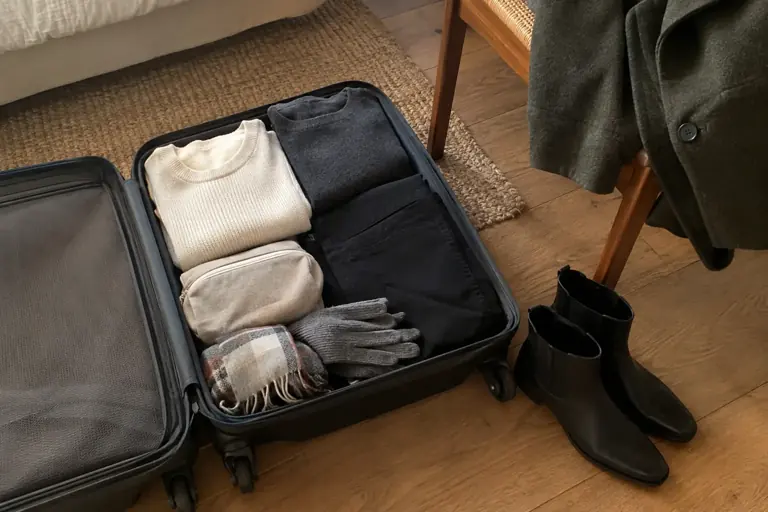
Keep the things you’ll need during the trip near the opening: a light layer, permitted accessories, and anything you’ll need when you arrive. Clothes you’ll wear later can be packed together. Packing cubes can help separate items by use, but they shouldn’t make your bag heavier or more complicated than necessary.
Roll or fold items depending on their fabric and shape. Compression can reduce the volume of some clothes, but it doesn’t reduce their weight and may add creases. Don’t force a zipper closed to save a few inches. If your bag is overflowing, look again at duplicates: a second chunky knit, pants you rarely choose, or an accessory without a clear purpose. Editing your packing list is often more useful than buying another organizer.
Do a full test with your bag zipped shut
Close the suitcase without sitting on it, then weigh it with the last-minute items inside. Check the size limits and conditions of your reservation again. Lift the bag and walk for a few minutes with any extra bag you may be carrying. This gives you a practical sense of what you’ll be hauling up stairs, through hallways, and between connections.
Plan for the return trip, too. Leave a little room for clothes that aren’t folded as neatly or for an item you take off during the journey. In Vestly, keeping your chosen outfits together makes it easier to find combinations without emptying the whole suitcase. After your trip, note which clothes you actually wore: that experience will help you pack lighter next time more precisely than any one-size-fits-all list.
Quiz
Is your compact suitcase ready?
The suitcase closes with heavy compression. What essential check remains?
See the answer
Check its weight and dimensions against your reservation. Volume and weight are two different constraints.
A second pair of shoes earns its place if…
See the answer
It serves a specific purpose the first pair doesn’t cover. Defining its role lets you compare its usefulness with the space it takes up.
Check off
My winter carry-on is ready
0 / 5
You’ve planned your stay and your journey, and kept your luggage volume under control.
Watch a practical example
A visual example from The Capsule Suitcase to compare with the steps in this guide.
Video in English
Frequently asked questions
Should you wear your heaviest coat on the plane?
You can wear it during the trip if it’s practical and comfortable. Just plan how to take it off and keep it with you when the temperature changes.
Do compression bags reduce weight?
No. They can change the volume, but the clothes still weigh the same. Always weigh your fully packed bag with a suitable scale.
Is there one carry-on size that works for every airline?
Check the terms of your booking and the airline operating your flight. Allowances can vary; a suitcase marketed as “carry-on” isn’t necessarily guaranteed to meet the requirements.
Practical source
- Air France, baggage conditions, accessed October 1, 2026; be sure to check the rules for your own booking.