Contents
- Identify the style, not just its appearance
- Check the pleats before you begin
- Tell the difference between washing that’s allowed and washing that’s needed today
- Follow the recommended level of agitation
- Prepare for drying without pulling on the pleats
- Don’t assume steaming is risk-free care
- Choose how to store it based on its construction
- Plan for travel and wear after storage
- Frequently asked questions
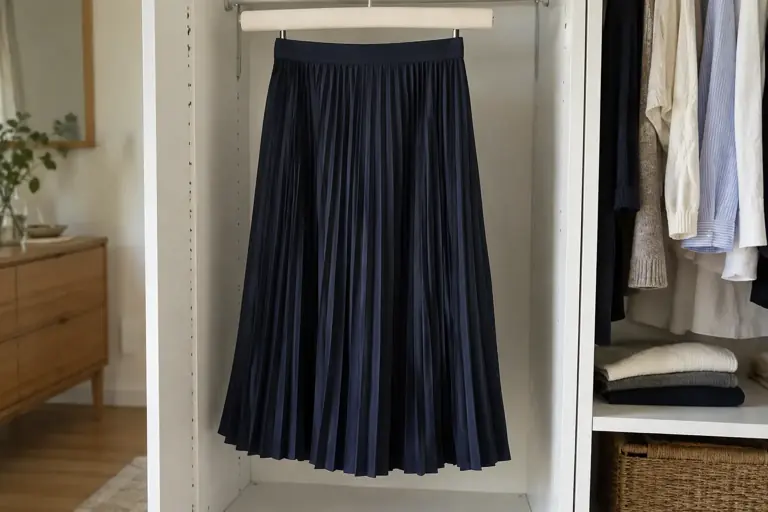
A pleated skirt can seem easy to store as long as it hangs nicely on its hanger. Questions often come up at the first wash: should you reshape the pleats, iron each ridge, use steam, or roll up the garment? There’s no one answer for every pleated piece, because the material and construction matter just as much as the way it looks.
To care for pleated clothing, check the instructions for that specific style before washing or applying heat to the fabric. Then prepare to dry and store it in a way that preserves its shape. A routine step for a smooth skirt may not work for another skirt whose pleats are a defining part of its construction.
Identify the style, not just its appearance
Read the fabric content and care label, then look for care instructions that match the exact style or reference. Two fabrics with fine, regular lines may react differently to washing and heat. The word “pleated” describes an appearance; it doesn’t mean you can automatically machine-wash or steam the garment.
The ISSEY MIYAKE care guide for example, provides specific instructions for several of its lines. PLEATS PLEASE’s recommendations apply to those products, not every pleated skirt on the market. Keep this in mind when searching online: a very detailed explanation is useful only if it truly matches your garment and how it’s made.
Check the pleats before you begin
Lay the garment flat without stretching it, and look at the pleats in even light. Distinguish a simple fold from storage, a crushed area, a seam that’s pulling, and a visible mark. If you’re unsure, take a few photos before caring for it, especially around the waistband, seat, or hem. That gives you a reference for describing the problem.
This check helps you avoid treating every irregularity as a crease to remove. Some volume is part of the design; other changes may point to tension or damage. If a seam is opening or the pleating has changed in one area after an incident, prepare a specific request for the brand or a professional. Our method for organizing clothing repairs helps you note the area, what’s needed, and the next step.
Tell the difference between washing that’s allowed and washing that’s needed today
Before starting a cycle, check why the garment needs care: a stain, odor, how long you’ve worn it, or visible dirt. Don’t choose a method just because another item already needs washing. A garment that needs special handling deserves its own time, with enough time to care for it as soon as the process is done.
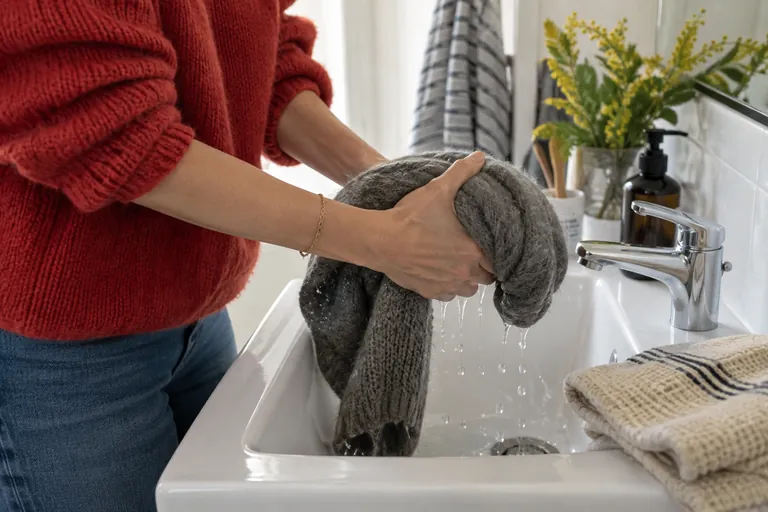
If water washing isn’t allowed, don’t substitute a basin on the grounds that hand washing is gentler. If a home method is allowed, read all its settings, including drying. Gather your supplies before wetting the fabric: a suitable container, compatible product, support, and enough space. That way, you won’t have to leave a damp skirt compressed while you look for room in a small bathroom.
Follow the recommended level of agitation
Temperature is only part of the instructions. Movement, cycle length, and spin can also matter for preserving the garment’s shape. Check your machine’s manual if the program name doesn’t make it clear exactly what it does. A “delicate” or “hand wash” button doesn’t replace comparing the settings with the garment’s care label.
For the relevant PLEATS PLEASE items, ISSEY MIYAKE recommends gentle treatment at a low temperature and specifies not to use fabric softener. This example applies only to the line named. It shows why it’s useful to read the fine print instead of remembering only a temperature. Don’t apply these settings to a silk pleated skirt or a lined dress: their care instructions may be completely different.
 Read alsoHow to wash a wool or cashmere sweater without felting it
Prepare for drying without pulling on the pleats
Before an approved wash, choose the recommended drying support. Leave enough space around the garment and keep it from getting caught between other items. Check the waistband, edges, and areas where a support might put concentrated pressure. How you hang or lay the garment is part of its care, not a step to improvise later.
Don’t pull on the hem to force extra length or “straighten out every pleat.” The goal is to follow the intended shape, not change it. If the brand provides instructions for reshaping the garment, follow them within the stated limits. Otherwise, ask for advice before taking significant action. Quick drying with unauthorized heat can undo the benefits of a carefully planned wash.
Don’t assume steaming is risk-free care
A garment steamer may seem reassuring because it doesn’t press the garment between two surfaces. But it still adds heat and moisture. So check whether it’s compatible, even if you don’t plan to iron the garment in the usual sense. Don’t start by testing a large visible area to see whether the pleats spring back.
The recommendation to avoid irons and steam appears in the PLEATS PLEASE care guidance cited above. Other garments, by contrast, may have their own finishing instructions. These differences don’t imply either a universal ban or general permission. If the pleats seem altered, photograph the area, identify the style, and ask for an appropriate solution before trying to recreate their pattern yourself with heat.
Choose how to store it based on its construction
A hanger is handy for looking at a skirt, but it isn’t necessarily the best choice for every storage period. Weight, waistband shape, and duration all matter. Avoid clips that mark a delicate area, hangers that are too tight, and heavy stacks that compress a garment whose volume you want to preserve.
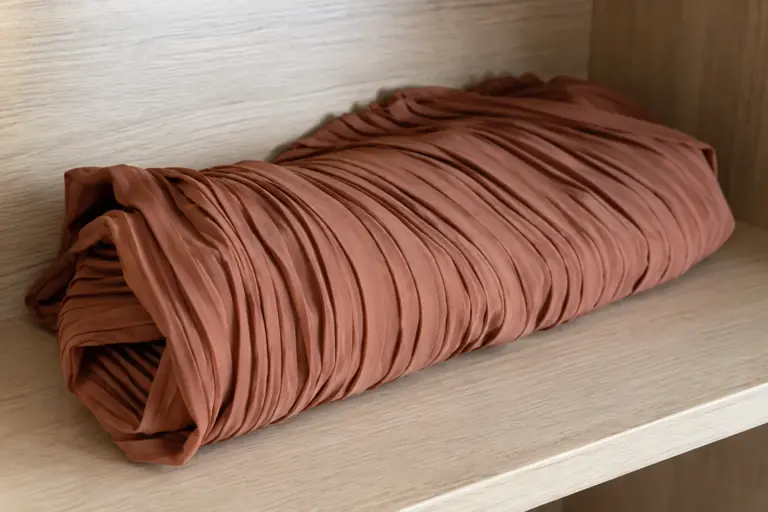
For some of its pleated pieces, the brand cited recommends rolling them in the direction of the pleats and warns against hanging them for a long time. Treat this as a product-specific instruction. For your item, check the available recommendation, then make room for it in your closet. Our guide to storing clothes between seasons also helps you check the location and make sure your garments are dry before storing them for a long time.
Plan for travel and wear after storage
When traveling, don’t squeeze the garment into an already full suitcase without considering its shape. Pack it according to the style’s instructions and keep it away from anything that could snag it. A zipper, buckle, or rigid accessory pressing against the fabric can cause a problem unrelated to the pleats themselves.
When you arrive, check how it looks without applying steam right away. After wearing it, check the garment’s condition, return it to a suitable place, and note any care questions you need to resolve. In Vestly , save the combinations that work with this skirt or pants so you can plan your outfit sooner. That way, you can plan for its care instead of trying to reshape it in a rush a few minutes before heading out.
Quiz
What should you do with these pleats?
Do pleats that look alike call for the same care?
See the answer
No, the material, construction, and style-specific instructions matter. The style name and care label are more precise than visual similarity.
Is steam automatically safe if it doesn’t touch the fabric?
See the answer
No, you need to check whether it’s compatible. Steam adds heat and moisture; some pleated lines prohibit it.
What should you do when a pleated area has lasting damage?
See the answer
Take a photo of the area and ask for advice about the garment. Avoid an irreversible change until you’ve identified a suitable method.
Check off
Preserve the pleats’ shape
0 / 5
Your preparation accounts for the entire garment, not just the appearance of its pleats.
Watch a practical example
A visual example from scholarwear to compare with the steps in this guide.
Video in English
Frequently asked questions
Can you iron a pleated skirt?
It depends on the garment. Some care labels prohibit ironing and steam; others give specific instructions. Check before trying anything.
Should you always hang pleated clothes?
No. Some garments are meant to be stored another way, such as rolled in the direction of the pleats. Follow the instructions for your specific item.
Do faded pleats come back after washing?
There’s no guarantee. Find out what caused the change and ask the brand or a professional for advice before washing, applying heat, or pressing the garment.