Contents
- What to look for on a clothing label
- How to read fabric content without treating it as a quality rating
- The five symbol groups, in the right order
- Care instructions decoder
- Why “30 degrees” doesn’t tell the whole story
- Three situations to sort out before laundry day
- Label, stain, and stain remover: how to weigh the information
- Keep care instructions handy without complicating your wardrobe
- Your checklist before the first wash
- Frequently asked questions
- Sources
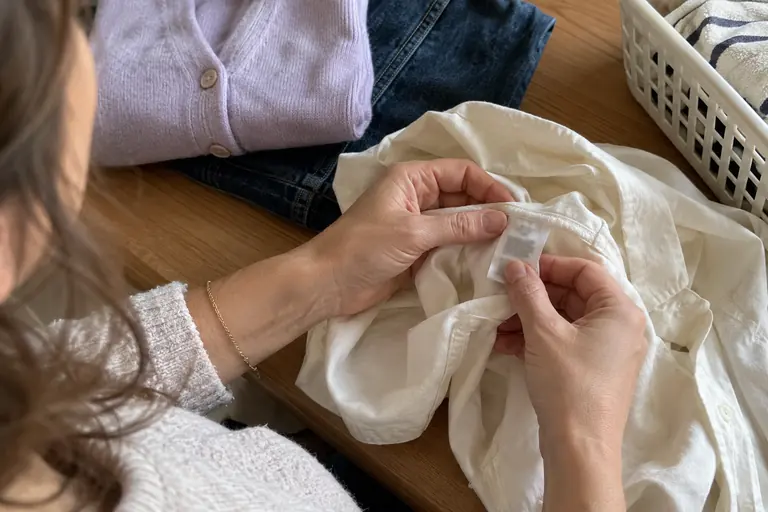
You turn a shirt inside out before washing it and find a strip of fabric covered in percentages, numbers, and tiny symbols. A “30,” a crossed-out triangle, a circle with a letter—where do you start? And does “100% cotton” mean you can use the same cycle as you do for all your other cotton clothes?
Read fabric content and care instructions separately. The first describes the fibers. The second explains how to care for this specific item, including its cut, finishes, lining, and trims. They complement each other, but one doesn’t replace the other.
This guide helps you find useful information, understand symbol families, and build a simple routine. The decoder describes the signs in words: it does not reproduce official pictograms and never replaces your garment’s label or the manufacturer’s advice.
What to look for on a clothing label
You don’t need to memorize everything the first time you read a label. Look for four things: the fiber names, any parts described separately, the care instructions in order, and any additional written directions. The size, style number, and brand can help you find the garment’s product details, but they can’t choose the cycle for you.
According to the DGCCRF, the fiber content label is required for relevant garments sold in France and must be legible in French. Care labeling is optional, though recommended. So the absence of care instructions doesn’t mean every treatment is allowed.
On a secondhand garment, the label may be worn, cut short, or missing. Don’t try to infer a definite method from the fabric’s feel alone. Keep the seller’s information, look up the style number if it’s still legible, and ask for tailored advice if you’re unsure.
How to read fabric content without treating it as a quality rating
A label such as “80% cotton, 20% polyester” describes the stated fiber mix. By itself, it doesn’t tell you whether the garment will be comfortable, durable, or easy to care for. Two items with the same fiber content can have different constructions, weights, and finishes.
Also look at which part it refers to. A jacket may list the outer fabric, lining, and trim separately. Don’t automatically apply the care habits for the main fabric to the whole garment. A finish, a combined material, or a decorative detail may call for extra care.
The Bercy guide to label information notes, among other things, that fibers are listed with their percentages and that sizing varies by manufacturer. It also distinguishes these details from origin information and other commercial claims.
To compare two purchases, turn the fiber content into practical questions instead: Have you enjoyed wearing a similar item? Can you follow its care instructions? Does it work with the clothes you already own? Our guide to sustainable fashion and thoughtful shopping takes this approach further without reducing your choice to a single material.
The five symbol groups, in the right order
The system presented by GINETEX organizes care into five treatments: washing, bleaching, drying, ironing, and professional care. Start by identifying the family before looking at the finer details.
| What you see | The care category | The question to ask yourself |
|---|---|---|
| A tub | Washing | Is home washing allowed, and under what conditions? |
| A triangle | Bleaching | What type of bleaching is allowed, if any? |
| A square, sometimes with a circle or lines | Drying | Should you check for tumble drying or a natural drying method? |
| An iron | Ironing | What heat or steam restrictions should you follow? |
| A circle, often with a letter | Professional care | What instructions should you give the professional? |
This chart uses verbal descriptions. To compare an exact drawing, its variations, or a symbol you don’t recognize, consult the official care symbol guide. Some symbols look alike: don’t choose a care instruction just because it’s close to what you think you see.
Care instructions decoder
Find the symbol on your garment, then open the matching row. Always read the entire label : washing alone doesn’t tell you how to dry it.
Your label
Choose a symbol to understand
Tub with a numberShowHide
The number indicates the maximum washing temperature, in degrees Celsius. It doesn’t specify the cycle on its own.
One bar under the tubShowHide
Use a gentler treatment with reduced mechanical action.
Two bars under the tubShowHide
Use a very gentle treatment. Check your machine’s manual for the corresponding program.
Hand in the tubShowHide
Hand wash. Don’t assume a program with the same name is automatically equivalent.
Crossed-out tubShowHide
Do not wash. Check the other instructions and ask for advice if needed.
Crossed-out triangleShowHide
Do not bleach. Also check the instructions for the product you use.
Crossed-out square with a circleShowHide
Do not tumble dry. Look for instructions on natural drying.
Horizontal line in a squareShowHide
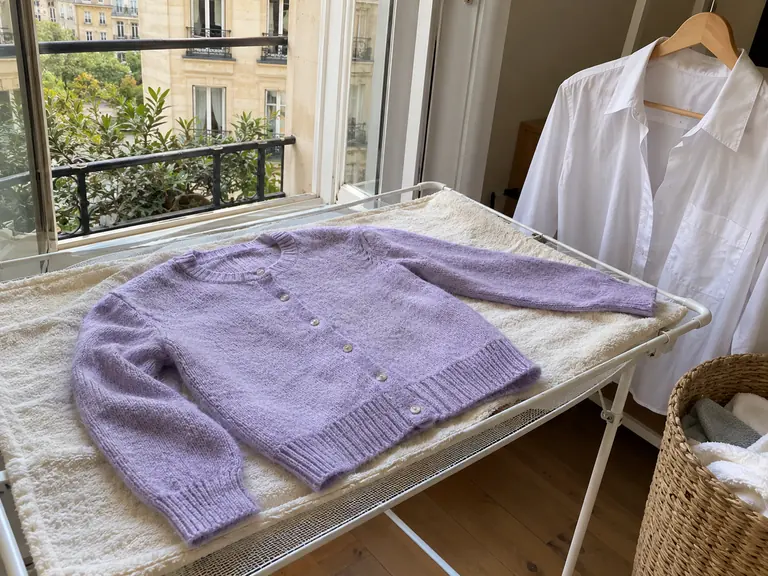
Dry flat. Follow any additional instructions, especially those about shade.
Crossed-out ironShowHide
Do not iron. Improvising a steaming method doesn’t give you permission to get around the instruction.
Circle with P, F, or WShowHide
Professional care instructions. Pass them along to a professional instead of trying to turn them into a DIY method.
 Read alsoCost per wear: the calculation that changes how you buy clothes
The washing symbols and prohibitions follow GINETEX ; those for natural drying and professional care can be compared in Clevercare. Dots, extra lines, and written instructions matter too. The decoder above is intentionally selective.
Why “30 degrees” doesn’t tell the whole story
The number in the tub catches your eye, but the other symbols matter too. A temperature limit alone doesn’t tell you what level of mechanical action to choose, how to spin, or how to dry the garment. So check the complete symbol, then your machine’s manual, since program names can vary.
Here’s an example of how to think it through, not a laundry formula: you find a number in a tub with one bar underneath. You’ve identified a maximum temperature and a request for gentle treatment. You still need to check the corresponding program on your machine, the label’s other restrictions, and any special instructions for the garment. Pressing “quick” because the cycle seems shorter doesn’t automatically answer those questions.
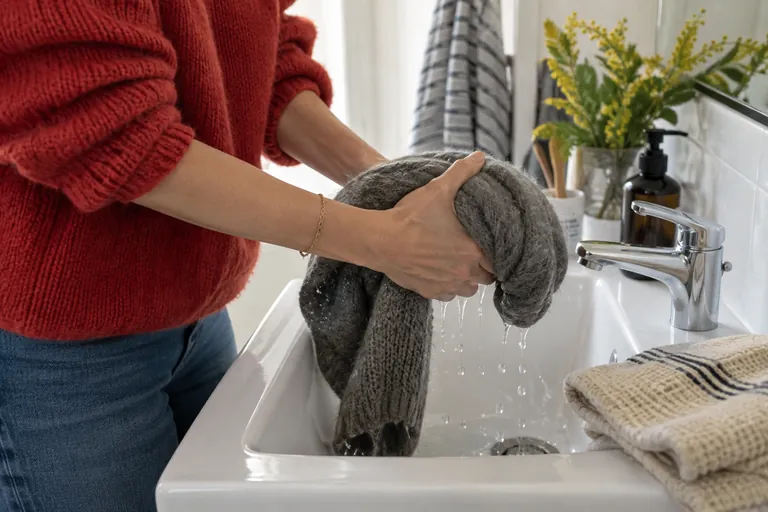
Another common mistake is copying the setting for a garment that looks similar. A lightweight sweater doesn’t necessarily get treated like another lightweight sweater. Before you start, check out our guide to washing wool and cashmere while keeping the garment’s label as your primary reference.
Three situations to sort out before laundry day
A new shirt you want to wear tomorrow
Resist the urge to put it straight into your next regular laundry load. Take a minute to read all the instructions and make sure you have the time and equipment needed to dry it. Your schedule matters: a piece that needs special care isn’t practical to prepare at the last minute.
Choose a backup outfit if you’re not sure you can finish caring for it in time. That way, you won’t have to rush the drying or ironing just to save the day’s plans. Your outfit planning can leave room for this little buffer.
A jacket with a lining and several labels
Gather the information before you decide. One label may list the fabric content, while another gives the size or care instructions. If different parts of the garment are described, don’t rely only on the first line you understand. Photograph everything and look up the style reference if needed.
For a structured, lined, or embellished piece, a specific question to the manufacturer or a professional is better than relying on a general method. Describe exactly what you see: the sequence of symbols, any written notes, and whether there’s a stain.
A secondhand piece with no readable care instructions
Looking up the style reference can help, but make sure the listing you find matches the exact same model. A similar name or a photo in a close color doesn’t guarantee the same fabric content or care instructions.
If you’re still unsure, avoid irreversible experiments and ask for advice. The guide to buying secondhand clothes can help you check these details before buying. An appealing piece is also one you can care for in your everyday life.
Label, stain, and stain remover: how to weigh the information
The label doesn’t know what kind of stain you just made. And the stain remover doesn’t know exactly how your garment is constructed. You need both pieces of information—and sometimes a second opinion.
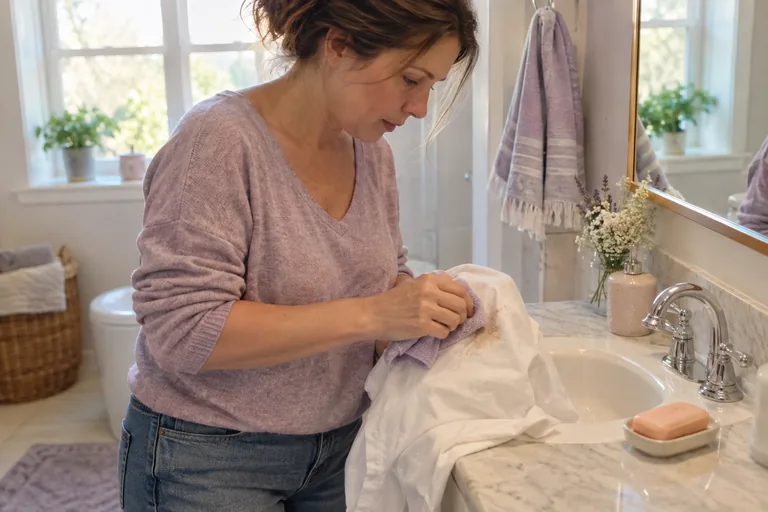
Read the garment’s restrictions and the product’s instructions before using it. Don’t mix household products to improvise a stronger solution. If you’re not sure the treatment is suitable, stop before applying it. The right move is to resolve the uncertainty, not to try more things on the visible area.
Our article on stains and fabrics can help you organize your questions. It doesn’t replace the specific instructions for the garment or those from the product’s manufacturer. For a valuable, delicate, or already damaged piece, give the professional as much information as possible about what you’ve used.
Keep care instructions handy without complicating your wardrobe
If a label bothers you, take a clear photo of it before doing anything else. Capture the fabric content, care instructions, and any style reference, then check that the small details are still readable when you zoom in. Also keep a photo of the garment so you can find the right document later.
A simple filing system is enough: “white long-sleeve shirt,” “mauve cardigan,” “black lined jacket.” Don’t save every photo under the generic name “label”—in a few months, they’ll be hard to tell apart. The goal isn’t to document everything perfectly; it’s to find reliable information when you need it.
In Vestly, you can organize your clothes in your digital wardrobe and mark a piece “In the wash” to temporarily leave it out of suggestions. This makes it easier to choose an available outfit. The app isn’t presented here as an automatic reader of care symbols : keep photos of your care labels in whichever tool you prefer and check the instructions yourself.
A realistic care routine also helps you get more wear out of your clothes. If you’re comparing several purchases, factor the time, alterations, or cleaning they’ll require into your thinking about the cost per wear, without pretending a single number can sum up the piece’s value.
Your checklist before the first wash
Check off
Things to check before you begin
0 / 6
You’ve gathered the information you need. Your garment’s own care instructions remain the reference when it’s time to care for it.
Watch a practical example
A visual example from Jeeves NY to compare with the steps in this guide.
Video in English
Frequently asked questions
Does “100% cotton” mean any kind of care is okay?
No. That label describes the fabric content. The garment’s construction, finishes, and trims also matter. Check the care instructions for that specific item before choosing how to wash, dry, or iron it.
Does a tub marked 40 always mean you have to wash it at 40 degrees?
The number indicates a maximum temperature under the symbol system presented by GINETEX. By itself, it doesn’t give you all the conditions for treatment. Check the other symbols, any special instructions, and your appliance’s manual.
Does “hand wash” mean my machine’s hand-wash cycle is suitable?
Don’t assume they’re equivalent. Check the garment’s instructions and your machine’s manual. If that combination isn’t clearly allowed, ask for advice before risking damage to the item.
Can I cut off the label and keep just a photo?
A clear photo can help you keep the information, but make sure it shows everything and is easy to match to the right garment. Keeping the label attached is still useful for professional care, donating, or reselling the item. Don’t lose the instructions just to make the garment feel less bulky.
What should I do if two care instructions seem contradictory?
Don’t guess and choose whichever seems less restrictive. Make sure you’re reading the label for the same item, then ask the manufacturer or a professional to confirm, showing them all the information.
Sources
- DGCCRF — Clothing labels, published October 28, 2024: the difference between fabric content and care.
- Bercy infos — The six details to look for on clothing labels, published September 19, 2025: fabric content, size, and other details.
- GINETEX — Care symbols, ISO 3758:2023 reference : treatment categories and how to read variations.
- Clevercare — Care symbols index : detailed reference for care instructions, especially drying and professional care.
Sources consulted September 30, 2026. The selective word descriptions are a reading aid; the official symbols remain the property of their respective owners. The photos are AI-generated illustrations and do not show a technical label to copy.