Contents
A closet that’s overflowing can paradoxically make you feel like you have nothing to wear. Clothes pile up, the pieces you love disappear beneath the ones you no longer wear, and every morning turns into a search. Sorting your wardrobe brings the things that matter back into view.
Sorting doesn’t have to be drastic or make you feel guilty. Here’s a four-pile method, questions to help you decide, and the best ways to give clothes you’re parting with a second life.
Getting ready to sort
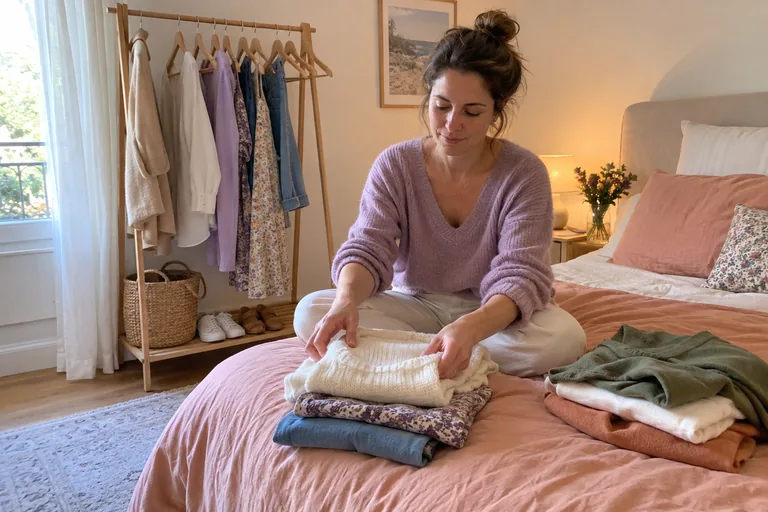
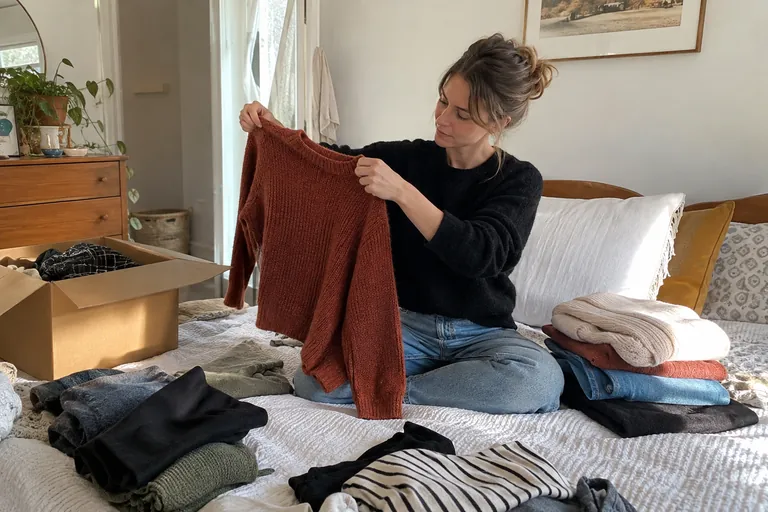
Set aside two to three hours, or work through one category at a time over several days: tops one evening, bottoms another. Get bags or boxes for the different piles, and a full-length mirror. A little music can help you keep your energy up.
If possible, work in daylight: it’s easier to assess colors and fabric condition. Keep your goal in mind: not to have less for the sake of it, but to get back to a wardrobe where you love every piece.
The four-pile method
Questions to help you decide
- Have I worn it in the past twelve months?
- Does it fit me now, not “when I’ve lost weight”?
- Do I feel good wearing it?
- Does it suit my life right now, my work, and my style?
- Would I buy it again today?
- Do I own other pieces that are almost identical?
If you answer no to most of these, you can probably let the piece go. If you describe your style in three words, as explained in our guide to find your personal style, also ask yourself whether the piece fits at least two of these words.
A visual example from Emily Wheatley to compare with the steps in this guide.
Video in English
The maybe box
The “maybe” box is the method’s safety net. Close it, write the date on it, and store it out of sight. If you haven’t needed anything inside after three to six months, donate it without opening it. If you’ve looked for a piece, take it out: it belongs in your wardrobe.
This tip helps you avoid regret and sort faster: instead of getting stuck on a piece, simply set it aside.
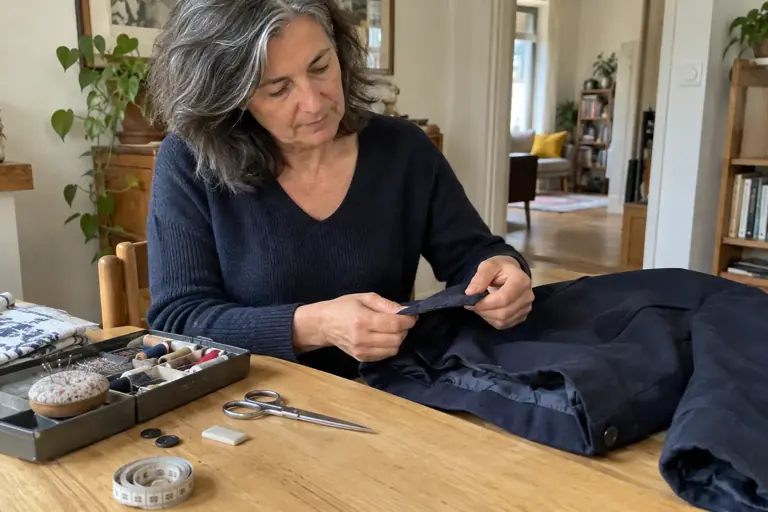 Read alsoOrganizing clothing repairs to get your pieces back in rotation
Common sorting traps
Sentimental clothes
A wedding dress, a loved one’s sweater, a concert T-shirt: you don’t have to wear them for them to deserve a place. Store them separately in a memory box so they don’t crowd your everyday wardrobe.
“Just in case” clothes
An outfit for a possible gala, pants for a possible hike: keep one for each activity you actually do, not ten.
Expensive clothes you’ve never worn
The money you spent is already gone; keeping the piece won’t get it back. Sell it instead—it’ll make someone else happy.
What should you do with clothes you’re letting go of?
- Sell : secondhand sites and apps, consignment shops, clothing swap events, for pieces in good condition or designer items.
- Donate : charities, reuse centers, people you know. Check what charities accept.
- Repair or transform : a hem, a button, a dye job, or an alteration can give a piece new life.
- Recycle : damaged textiles can be dropped off at designated collection points to be reused or recycled.
Decluttering is also a chance to think about future purchases: our article on sustainable fashion offers tips for buying less but better.
Take stock of what’s missing
Decluttering also reveals what’s missing: a jacket for in-between seasons, pants that go with all your tops, comfortable shoes for walking. Add these gaps to a list in order of priority instead of rushing to the shops right away. Use the list to guide your next purchases: if a piece isn’t on it, wait.
This is often when you realize the problem wasn’t that you didn’t have enough clothes, but that you didn’t have enough pieces that work together. It’s the starting point for a minimalist wardrobe.
After sorting: organize and care for your clothes
Once you’ve finished sorting, organize what’s left so everything is visible and easy to reach. Our method for organizing your closet picks up from there. To keep your closet from filling up again, follow one simple rule: for every piece that comes in, one piece goes out.
Frequently asked questions
How often should you declutter your wardrobe?
A full closet cleanout once or twice a year, ideally at the change of seasons, is enough. In between, a quick tidy as you go prevents things from piling up.
How many clothes should you keep?
There’s no right number. What matters is that you wear each piece and can see everything at a glance.
Do you have to declutter everything at once?
No. Working through one category at a time over several days is often more effective and less exhausting.
Where can you drop off damaged clothes?
At textile collection bins, found in many towns and outside some stores. They accept clothes, even worn or torn ones, as long as they’re clean and dry and placed in a closed bag. The clothes will be sorted for reuse or recycling.