Contents
- Who might consider an iron-on hem?
- Which kinds of tape should you distinguish first?
- How do you check the fabric and care label?
- How do you choose the length before fixing the fold?
- How much tape and what width do you need?
- What should a small test show before application?
- How do you apply the tape without mixing up instructions?
- Why is the hem coming unstuck?
- What care limits apply after the alteration?
- Can you remove the tape and restore the original length?
- What should you keep for the next time you wear the pants?
- Frequently asked questions
- Sources
A pants leg that is too long needs a length fitting before it is fixed. Tape can replace some stitches, but it cannot correct a cut that pulls at the hips, a lining that is too short or a heat-sensitive finish. Start with compatibility rather than a universal pressing time.
Who might consider an iron-on hem?
Iron-on tape may suit a simple alteration when the garment is compatible with its application. It does not replace every sewn finish. For pants you wear often, assess the drape, movement and care needs before deciding.
The quickest repair does not always leave the most options. Hand stitching may be preferable when you want to change the length again, protect a valuable piece or ask a professional to examine the fabric. Get the owner’s permission before bonding or cutting a borrowed garment.
| Your situation | First decision | What still needs checking |
|---|---|---|
| Compatible instructions and care label; length chosen | A small hidden test may be possible | Appearance, flexibility and adhesion after cooling |
| Ironing prohibited or instructions incompatible | Choose another finish | Stitching or advice from an alterations shop |
| Jersey or stretch fabric | Look for instructions suited to that fabric | Stretch retained and any required stitching |
| Length still undecided | Try a temporary fitting | Shoes, walking, sitting and the wearer’s agreement |
| Instructions or care label missing | Do not guess the heat setting | Manufacturer information or professional assessment |
If several pieces need attention, our method for organizing clothing repairs helps separate a button repair, a hem and a job to leave to a professional. Sorting them first avoids treating every alteration as the same bonding task.
Which kinds of tape should you distinguish first?
Fusible tape joins fabric layers with heat-activated adhesive. Basting tape may only hold pieces before sewing. A similar-looking roll does not tell you a product’s purpose.
Prym’s official product sheet for Wonder Tape describes temporary adhesion and dissolution in the wash. Do not present it as a permanent no-sew bond. A tape intended to form a hem has its own application and care instructions. Read the exact name and reference rather than relying on the words double-sided.
A visual example from Sew Essential to compare with the steps in this guide.
Video in English
Interfacing can change the structure of fabric or reinforce an area. A product that stiffens a collar is not automatically right for a flexible pants hem. Before buying, check the stated purpose, any backing to remove, the width and the intended fabrics.
Tool 1 · Tell the products apart
Three tapes, three different purposes
Open the case that resembles your purchase, then compare the actual instructions.
A tape applied with an iron
Place the fusible adhesive inside the fold according to its instructions. Check the backing, width, application and washing limits of that exact product. The words no-sew are not enough.
Temporary adhesive tape
Prym Wonder Tape holds pieces before sewing and dissolves in the wash. Do not treat that temporary purpose as a permanent bond for a pants hem.
A product intended to reinforce fabric
Interfacing and hem tape may serve different purposes. Look for the stated use on the package; do not borrow application instructions from another box marked fusible.
How do you check the fabric and care label?
The garment care label and product instructions must permit the same working conditions. A fiber name such as polyester or cotton does not determine the setting: the piece may have a more sensitive finish, construction or decoration.
GINETEX says to choose the maximum iron temperature from the care label. Its current guidance distinguishes limits of 120, 160 and 210°C, including low-temperature ironing without steam. These are care limits, not a universal fusible-tape application recipe.
A crossed-out iron means you should not use a product that requires ironing. A pressing cloth does not override a prohibited treatment. If the tape requires conditions the garment cannot tolerate, choose another finish rather than arbitrarily changing the heat.
Tool 2 · Check the conditions
What should you check before using the iron?
This tool does not approve the fabric or adhesive strength. It flags missing information or a declared incompatibility.
Do not heat or cut without both sets of instructions. A glued finish does not guarantee clean removal.
The stated heat requirements are incompatible. Put the iron aside and consider a sewn finish or advice from an alterations shop.
The product excludes this fabric or use. Choose another finish; a test does not override that exclusion.
A required compatibility check is missing. Find the garment care label and tape instructions before heating or cutting.
Restoring the old length matters to you. Adhesive may leave a mark; first consider a suitable sewn option or an alterations professional.
You have declared that both compatibility checks are complete. The next step is a hidden test following the instructions, without a guarantee of success or clean removal.
Without JavaScript: heat prohibited or use excluded → another finish; information unknown → wait; clean removal needed → consider sewing first. If the conditions agree, start with a hidden test.
 Read alsoHow to wash a wool or cashmere sweater without felting it
Our guide to ironing clothes without damaging them covers the checks for different areas. The tools above guide a check; they cannot identify your fabric or read your care label from a photo.
How do you choose the length before fixing the fold?
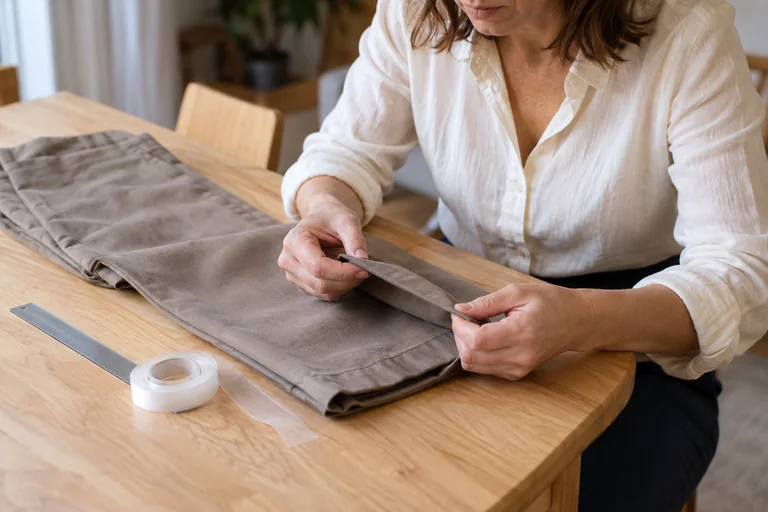
Try on the pants with the shoes you intend to wear. Hold the fold temporarily so you can assess the length while standing, walking and sitting. Make those comparisons before cutting fabric or activating adhesive.
Check the two legs separately. Crooked positioning, a waistband worn higher or different shoes may change what you see. There is no single required distance from the floor: choose a practical length that preserves the drape you want.
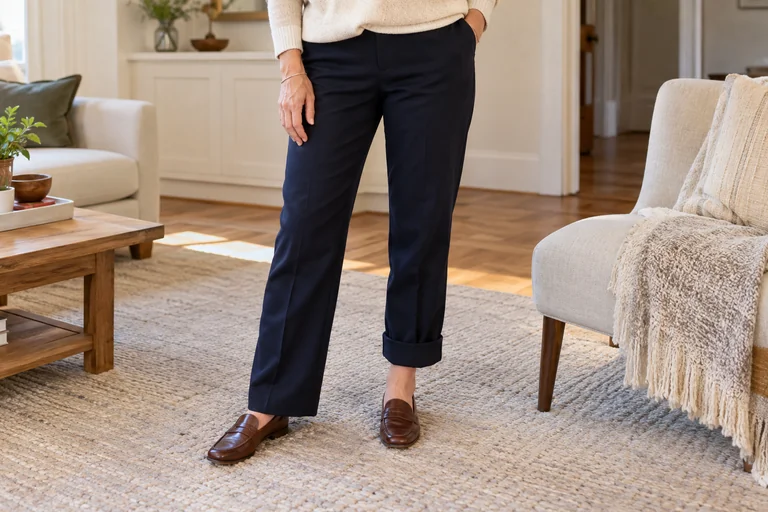
The guide to pants length with different shoes covers that styling choice. The tape calculator answers a different question: how much material do you need to go around the two chosen leg openings?
How much tape and what width do you need?
Tape length follows the circumference of each leg opening. Tape width must fit inside the fold as specified in the instructions. These two dimensions are not interchangeable.
The tool adds two separately measured circumferences and your chosen total allowance. It then compares that length with the roll length you enter. It calculates neither fold depth nor a seam allowance to cut from the garment.
Tool 3 · Work out the tape length
Two leg openings and an allowance you choose
Measure around each leg at the future hem. Use the same unit for every value in one calculation. The tool does not choose tape width or fold depth.
Chosen example: 45 cm on the left + 45 cm on the right + 10 cm total allowance = 100 cm. One 300 cm roll is enough for this example.
On paper, add both circumferences and your total allowance. Divide by the roll length and round the roll count up. Check tape width and compatibility separately.
A measurement is missing or invalid. Use one unit, no more than two decimal places and a positive value for each circumference and the roll length. The allowance can be zero.
The unit has changed. Enter every measurement again in that unit before calculating.
Tape required: {needed} {unit}. Number of rolls of {roll} {unit}: {rolls}. The allowance is the one you entered. This result does not approve the tape width or compatibility.
Measurements cleared. Find both leg circumferences, your chosen allowance and the roll length.
For a flat measurement, check what you are actually measuring: one flattened side is not a full circumference. Our guide to taking useful clothing measurements distinguishes body measurements from garment dimensions. Here you are measuring the bottom of the pants, not the wearer’s ankle.
The calculator adds no automatic safety or performance allowance. Your allowance can cover a test and the method specified for your product. For a partially used roll, enter its known remaining length or use the total tape length without claiming to know your stock.
What should a small test show before application?
A test on a compatible scrap or a suitable hidden area lets you observe the effect of the prescribed treatment. It may reveal a mark, a change in flexibility or poor adhesion. It does not prove lasting performance through every future wash.
Vlieseline’s Wundaweb instructions describe pressing one area at a time with a damp cloth, without sliding the iron, then cooling flat for twenty minutes. That sequence applies to that product. Another tape may have release paper and a different method; copying the same movements does not replace reading its instructions.
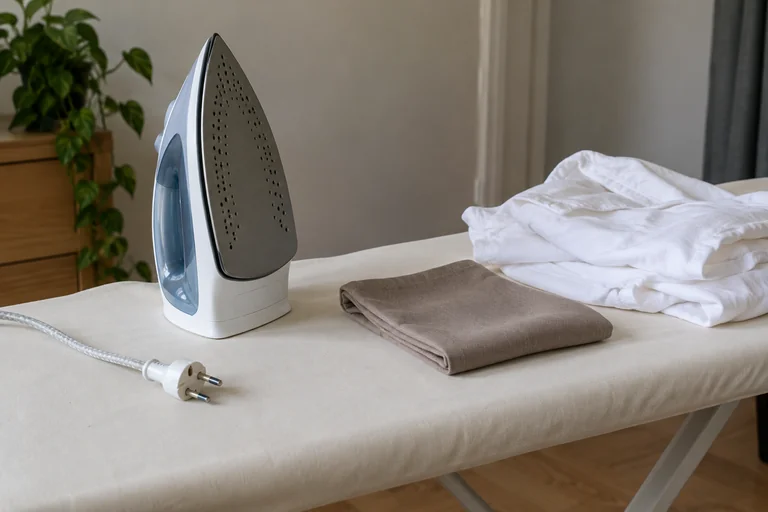
After the required cooling time, inspect both sides and the flexibility of the fold. Record the exact product and conditions followed. Stop if the fabric becomes marked or the instructions cannot be followed; stronger reheating is not an automatic fix.
How do you apply the tape without mixing up instructions?
Keep the tape between the layers specified in its instructions and make sure no adhesive extends toward the soleplate. Release paper, orientation and removal steps depend on the product.
The product sheet for Ourlet parfait sans couture from Vlieseline requires a fold at least four centimeters deep and excludes jersey. It specifies approximately ten seconds of pressure with a damp cloth. Its construction differs from simple paper-free webbing; choosing a narrower tape does not make those dimensions universal.
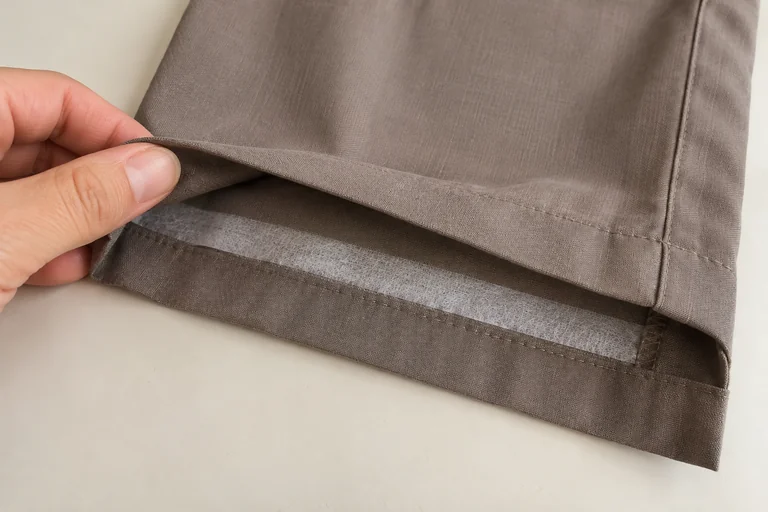
Remove any holding accessories that are not heat-compatible before application. Work on a suitable surface while the pants are off your body. Keep hands clear of the heated area and leave the iron in a stable position when moving between areas. Follow the garment label and product instructions throughout.
Why is the hem coming unstuck?
A lifting hem calls for checking application, product and fabric. It does not identify one universal cause. Incorrect application, an incompatible surface or an area under strain may each need a different response.
First check the product reference, tape orientation and required cooling. Then look at where it has failed to bond: everywhere, over a thick seam or where the fabric moves. Those observations help the manufacturer more than simply saying it does not stick.
Avoid stacking tape or extending the heating time without suitable instructions. That can add bulk and complicate a later finish. If the garment already pulls, have its fit assessed rather than expecting adhesive to make it larger.
What care limits apply after the alteration?
Care must suit both the garment and the added bond. A temperature allowed for tape does not raise the garment’s limit. The more permissive product does not override the other’s restriction.
The Vlieseline sheets consulted specify, for example, 30°C for Ourlet parfait and 60°C for Wundaweb. Those different limits show why a blanket instruction to wash every iron-on hem at 40°C would be misleading. They do not guarantee a particular number of successful washes.
For jeans, also follow the guidance for washing and drying denim. Check tumble drying and professional cleaning separately. If care that the garment needs is incompatible with the tape, reconsider the finish.
Can you remove the tape and restore the original length?
Tape intended to create a lasting hem does not guarantee clean removal. Leaving the fabric uncut preserves available length, but adhesive can leave residue, stiffness or a color difference.
Do not confuse that with the temporary Prym Wonder Tape. Ask the manufacturer of the exact product or a professional about removal. A solvent recommended on a forum is not approval for your fabric and may cause further damage.
If the length is still undecided, start with a temporary fitting or stitching suited to a future adjustment. You can decide not to bond anything. An intact piece leaves more options than a rushed alteration.
What should you keep for the next time you wear the pants?
Record the chosen length, shoes tried, product and compatible care.
Tool 4 · Keep a preparation sheet
What is checked and what still needs doing
Check only what you have actually verified. The export stays on your device, without an account or automatic saving.
Checks completed: 0 of 6.
Without JavaScript, you can check this list on the page or copy it onto paper. Application follows the product instructions rather than a score.
Checks completed: {checked} of {total}. This count does not approve an application.
My hem preparation sheet
Personal checklist, not a compatibility approval. Read both sets of instructions again before application.
TXT sheet created on this device. Vestly does not save a copy.
You can then find the pants among your saved clothes in Vestly and build an outfit from pieces already in your closet. The app does not test hem adhesion. These web tools help prepare an alteration; their fields stay local and are not saved automatically.
Decide on an iron-on hem after the fitting, the instructions check and a hidden test.
Frequently asked questions
Is iron-on hem tape always temporary?
The exact product determines its purpose. A lasting bond is different from basting tape that dissolves in the wash. Do not expect clean removal without the manufacturer’s instructions.
Can you use it on a garment marked do not iron?
A product that needs an iron is incompatible with that restriction. A pressing cloth does not override the care label. Consider a sewn finish or an alterations professional.
Should you use steam?
The tape instructions and garment care label must agree. A damp pressing cloth and the iron’s steam setting are different instructions. No single rule applies to every tape.
Is the tape suitable for jersey?
Look for instructions covering the stretch fabric and its finish. The Vlieseline Ourlet parfait product discussed here excludes jersey. Another tape may also require stitching.
How should you wash the garment afterward?
Follow compatible garment and tape limits without raising the garment’s limit. The product sheets cited give different instructions; no number of successful washes is guaranteed here.
Do the tools send my measurements anywhere?
Calculations and choices stay on this page. Nothing is saved or sent automatically. Downloading only creates the file you request on your device.
Sources
- Vlieseline: Ourlet parfait sans couture, application and product limits
- Vlieseline: Wundaweb, pressing areas and cooling
- Prym: Wonder Tape, temporary holding before sewing
- GINETEX: care and maximum ironing temperatures
- Sew Essential · Sewing Tips Q&A #2 from Sew Essential. Video selection checked October 24, 2026.
Sources checked October 24, 2026. Manufacturer figures apply to the named products, not to every item described as fusible.