Contents
- Start with how you’ll wear it, not a number
- What the fiber content and fabric weight really tell you
- Do a first test without damaging the knit
- Check opacity standing, sitting, and moving
- Why a white T-shirt shows your underwear
- Choose underwear based on the result you want
- Check the neckline and finishes before deciding
- Keep it looking the same after you buy it
- What to do with a see-through white T-shirt
- A decision in five checks
- Frequently asked questions
- Sources and references
To choose an opaque white T-shirt, compare the fabric in the light, try it on without stretching it too much, and check the look with the underwear and bottoms you plan to wear. The fiber name, price, or a single fabric-weight figure can’t replace these checks.
A T-shirt looks perfectly white on its hanger, then reveals a tag, the seams of your underwear, or your waistband once you put it on. The disappointment often comes from trying it on too quickly: you checked the color and size without seeing how the shirt looks in the conditions you’ll wear it in. The goal is to find a piece you’ll want to wear on its own, without needing to add an unexpected layer.
Start with how you’ll wear it, not a number
Are you looking for a T-shirt to wear on its own in summer, as a first layer under a shirt, or as a polished piece to pair with dress pants? These three uses call for slightly different compromises. A lightweight style may work under a jacket but feel too sheer on its own. On the other hand, a thick, structured knit may not be flexible enough if you want to tuck it into a flowy skirt.
Before comparing, write down the two outfits you plan to wear this T-shirt with. If you’re trying them on at home, take out the pants, skirt, or cardigan you’d pair it with. This reference helps you avoid buying a “perfect basic” in theory that doesn’t work with what you actually wear. Our guide to recognizing a well-made garment then rounds out your construction checks.
What the fiber content and fabric weight really tell you
The fiber content answers the question “what fibers is it made from?” It doesn’t, on its own, describe the fabric’s density, structure, finish, or how the knit behaves. So two T-shirts with the same fiber content can look very different. The DGCCRF underscores the importance of reading this information and any care instructions provided.
Fabric weight is the mass of fabric per unit of area. If it’s listed, it can help you place a style within a range, but it doesn’t set a universal dividing line between sheer and opaque. The textile’s structure still matters: CottonWorks for example, describes jersey and interlock as constructions with distinct characteristics. So don’t treat a product listing’s weight as a guarantee of opacity, especially when comparing different brands and fabrics.
In practice, use this information to narrow down your choices, then let the try-on decide between styles. If a seller says “opaque,” ask whether the photos show the piece without an undershirt. A heavily brightened photo or one showing several layers won’t tell you how the T-shirt looks on its own.
Do a first test without damaging the knit
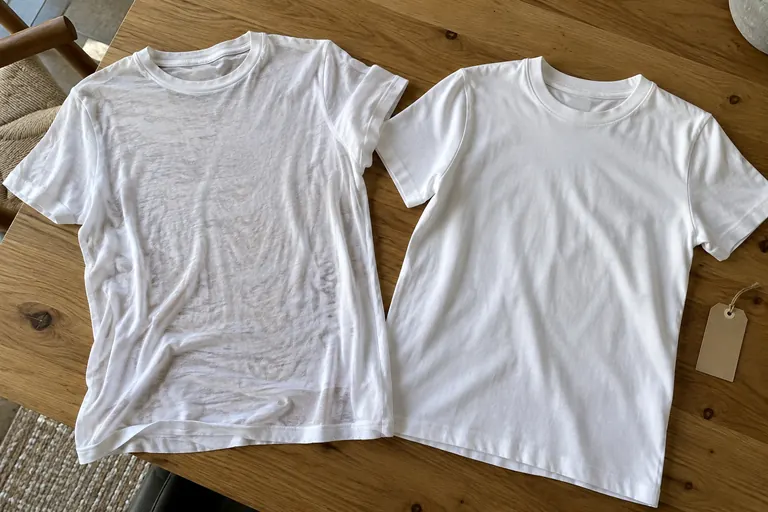
Hold a single layer in front of a contrasting surface, then look without pulling it. Notice the difference between an evenly white area and the small gaps visible between the knit stitches. This first test lets you compare two fabrics under the same conditions; it isn’t meant to rule out every piece that lets a little light through.
Avoid stretching the garment hard between your hands. That doesn’t necessarily reflect how it fits when worn and can distort a new piece. Try it on instead, since the transparency that matters is how the fabric looks against your body. If you’re comparing several styles, keep the lighting and underwear the same. Otherwise, you may mistake a difference in the setting for a difference in the T-shirt.
Check opacity standing, sitting, and moving
Close the fitting room curtain, stand a normal distance from the mirror, and look at the garment from the front, side, and back. Notice where the fabric pulls: across the chest, upper back, or stomach when you sit down. A garment may look opaque where it hangs loosely and more revealing where it’s stretched.
Raise your arms as if reaching for something, stretch them out in front of you, and sit down. The neckline should feel comfortable, and the sleeves shouldn’t make you keep adjusting the top. If the seams pull, try another size or cut. Sizing up isn’t the only answer: a straighter style or a different armhole may fit better without adding extra volume elsewhere.
At home, also check the garment near a window, without deliberately putting yourself in strong backlight. Ordinary side lighting may reveal what the fitting room lights concealed. A photo can help, but phone settings sometimes change the contrast, so don’t decide based only on an overexposed image.
 Read alsoClothing labels: understanding fabric content and care
Why a white T-shirt shows your underwear
Several factors can add up. The knit may be lightweight or loosely constructed, the fit may pull across the chest, shoulders, or stomach, and bright light passes through fabric more easily than soft light. Contrast matters too: underwear in a distinct color shows through more easily than a shade close to your skin.
Care matters too. Knit fabric that isn’t washed according to its care instructions can loosen and look thinner over time. If a T-shirt was opaque when you bought it and no longer is, first consider how it has been cared for.
Choose underwear based on the result you want
If you want your underwear to show as little as possible, compare a shade close to your skin with the color you usually wear. White isn’t automatically the most discreet under white: what matters in your try-on is the contrast between areas. Seams, lace, and edges can also show through even when the color is hard to see.
You can also choose to layer intentionally. In that case, a camisole is part of the outfit and adds warmth; it shouldn’t become an obligation you discover after buying the garment. Under a shirt, the guide for wearing a white shirt offers useful combinations. Just check that the result gives you the opacity or layering you want and stays comfortable throughout the day.
Quiz
Is your comparison reliable?
Two T-shirts have the same fabric content. Can you conclude that they have the same opacity?
See the answer
No, construction, fit, and trying it on matter too. Fabric content is useful information, but it doesn’t tell you everything about the fabric or how much it stretches when worn.
The fabric only looks see-through where it’s under a lot of tension. What should you check first?
See the answer
The size and fit during everyday movements. Care can’t replace a proper fit, and unapproved heat can damage the garment.
Which comparison is most helpful?
See the answer
Both styles with the same underwear and in the same lighting. Comparable conditions help you distinguish fabric quality from the effects of how it’s presented.
Check the neckline and finishes before deciding
Opacity isn’t the only thing that makes a T-shirt comfortable. Check that the neckline lies flat, the side seams look even, and the hem stays flexible. Gently turn the garment inside out to inspect it. Loose threads alone don’t prove poor quality, but an open seam, a hole, or an already misshapen edge is worth pointing out.
Check the length with the bottoms you plan to wear. Tuck the T-shirt in, then wear it untucked: do you like the volume both ways? If you plan to pair it with cream tones, take time to compare the whites, too. The guide pairing white and ivory helps you make the difference a deliberate pairing instead of a surprise.
Keep it looking the same after you buy it
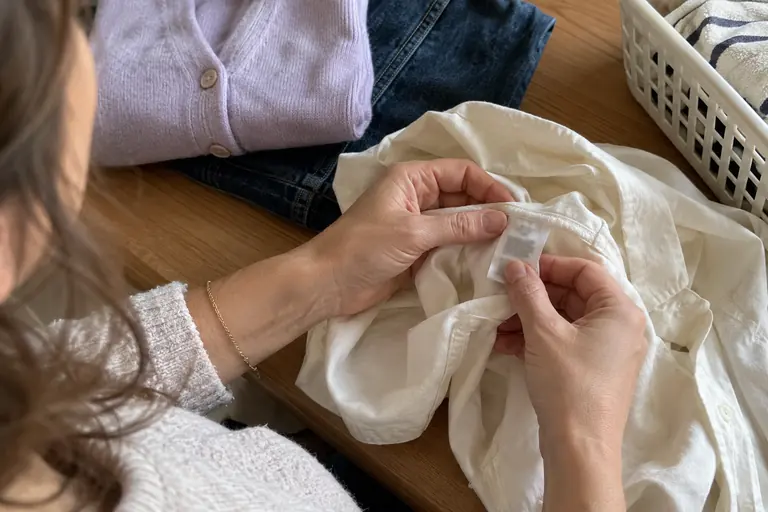
Read the care instructions before the first wash. For a new item, the guide to washing new clothes for the first time explains the steps to follow. A white T-shirt doesn’t automatically mean you can wash it at a very high temperature, use bleach, or put it in the dryer. GINETEX explains that care instructions apply to specific treatments and have limits you need to follow. You can find these guidelines in our article about understanding clothing labels.
Sort by color and care instructions, as in our guide to sorting your laundry, use the amount of detergent recommended on its label, and let the garment dry completely before putting it away. If its shape or appearance changes unexpectedly despite following the care instructions, keep the label, proof of purchase, and helpful photos so you can contact the seller. Don’t keep trying different bleaching remedies: they could add another problem to the one you’re trying to fix.
What to do with a see-through white T-shirt
If you already have the style and it shows your underwear, you still have a few options before deciding to get rid of it:
- change your underwear to a shade closer to your skin tone, or to a style that shows less beneath the fabric;
- wear it as a base layer under an open shirt, jacket, or sweater, checking that the neckline and hem don’t stick out;
- save it for intentional layering, with a camisole or tank top that’s part of the look;
- save it for lounging at home, where the sheerness matters less.
Washing won’t reliably fix this problem. Either way, check the seller’s return policy before wearing the garment.
A decision in five checks
Check off
My white T-shirt works for how I plan to wear it
0 / 5
You checked the whole garment, not just the promise on a product page.
Finally, keep a record of the combination that works: T-shirt, bottoms, any underlayers, and outer layer. In Vestly, a photo of the piece and a saved outfit make it easier to find again. The point isn’t to collect more white T-shirts, but to identify the one that really does its job in your wardrobe.
Watch a practical example
A visual example from Tifflo to compare with the steps in this guide.
Video in English
Frequently asked questions
Is a thick white T-shirt always opaque?
No. Thickness can help, but the knit, fit, light, and fabric tension still matter. Check it on rather than relying on how it feels to the touch.
Should you choose a size up?
Only if it fits better when you try it on. A different cut may ease tightness in one area without making the shoulders or sleeves too big. Comfort and how it looks matter more than the letter on the tag.
Can you make a sheer T-shirt opaque by washing it?
That’s not a reliable method. Follow the care instructions and choose either a layering piece you like or another style if you want to wear the T-shirt on its own.
What fabric should you choose for an opaque white T-shirt?
No fabric guarantees opacity on its own. A tighter knit and more structured construction often help, but the fit and fabric tension against your body matter just as much. Check the fiber content on the tag, then try it on before deciding.
Can you wear an opaque white T-shirt under a shirt or jacket?
Yes, it’s a common way to wear one. Check that the neckline doesn’t show, the hem stays tucked in or hangs neatly untucked, and the look holds when you raise your arms. A lightweight style may work under a jacket, but try it with the outer layer first.
Sources and references
- DGCCRF, clothing labels, accessed October 1, 2026.
- CottonWorks, jersey and interlock constructions, accessed October 1, 2026.
- GINETEX, care symbols, accessed October 1, 2026.