Contents
- Sort laundry in six steps
- Start with items that need special handling
- Read care instructions as shared limits
- Separate colors without relying on a miracle accessory
- Consider fabrics and details that can snag
- Sort as you go
- Choose a setup that fits your available space
- Keep damp items separate until you can take care of them
- Prepare the cycle without overloading the load
- Plan for different laundry loads
- Frequently asked questions
To sort your laundry, make loads with compatible washing instructions, then check colors, fabrics, and prep steps. The hamper is overflowing, but the clothes inside may not all belong in the same wash. Sorting only into lights and darks overlooks other differences: hand washing, mechanical action, finishes, drying method, or a stain that needs a closer look. A good system helps you spot these cases before you’re standing in front of the washer.
Plan for what happens after the wash, too. The best system isn’t the one with the most hampers, but the one you can actually use and keep up to date.
Sort laundry in six steps
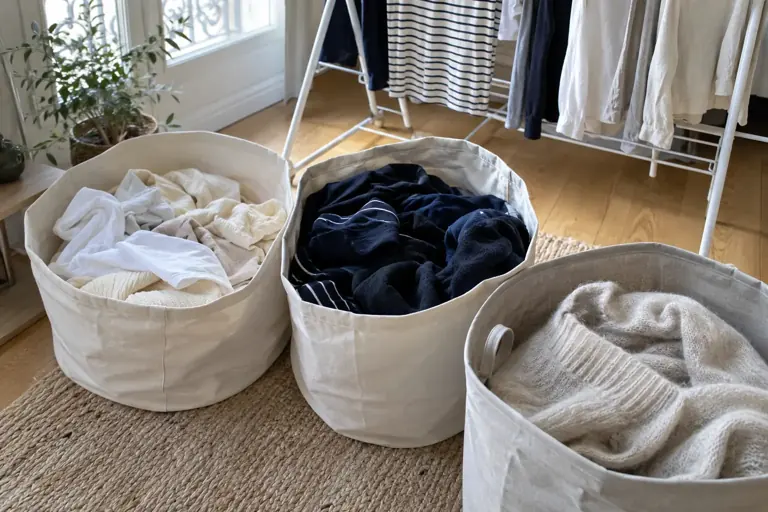
- Empty the hamper onto a clean surface and set aside items that need special attention: professional cleaning, hand washing, a stain, or an unclear care label.
- Read the care labels on the remaining items and group together those with compatible washing instructions.
- Separate heavy fabrics, like towels or jeans, from fine, delicate items, like lightweight blouses or lingerie.
- Within each group, sort by color: lights on one side, darks on the other, and new items or those likely to bleed separately.
- Check pockets, zippers, and anything that could snag, then turn inside out any items that could be damaged in the wash.
- Get ready for drying before you start the wash: set up a drying rack, hangers, or a flat surface, depending on the item.
Start with items that need special handling
Before sorting laundry by color, set aside clothes that need special attention: professional cleaning, hand washing, an unclear care label, a repair, or a stain to identify. They shouldn’t disappear at the bottom of the everyday laundry hamper, where someone might toss them into a wash without knowing their situation.
Set up a small holding area with a clear next step. It could be an open box for dry-clean-only items, a suitable hook, or a note linked to the item’s reference. Avoid a vague category called “delicates” that ends up mixing everything together. Our guide to hand washing helps you organize this separate task, while an item meant for a professional should remain identifiable until it’s taken in.
Read care instructions as shared limits
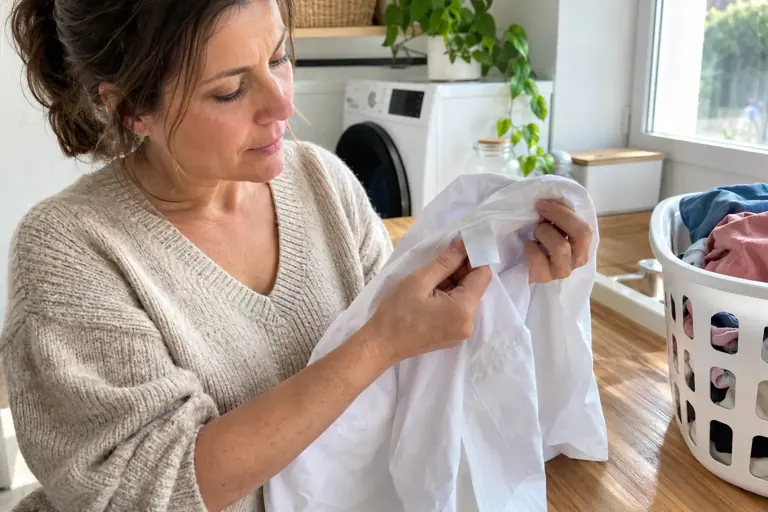
Compare the care instructions for the clothes you’re considering for the same load. Temperature isn’t the only factor: check the mechanical action and any restrictions, too. The care symbols explained by GINETEX also help you understand the fabric composition. Our guide to understanding clothing labels goes into more detail about fabric composition. If an item requires a method that isn’t compatible with the load, take it out instead of choosing a rough compromise.
Keep your washer’s manual or an easy way to access its programs nearby. Product names don’t always describe every setting, and the same name can refer to different cycles depending on the machine. Build your own reference based on your clothes and your washer, not a universal list of temperatures by color. White alone doesn’t mean an item can handle a hotter wash, and dark colors don’t define a fabric.
Separate colors without relying on a miracle accessory
Once you’ve identified compatible care instructions, check the shades and contrasts. Be especially cautious with new clothes or items whose behavior in the wash is still unknown. Don’t assume a dark, bright, or multicolored item is risk-free just because you’ve worn it several times without any visible problems.
Our guide to the caring for new clothes for the first time explains why this step deserves some preparation. For raw or dark denim, the guide to caring for jeans covers sorting by color, washing, and drying. If an item has already bled, keep it identified and consult the guide to color bleeding. A sheet or additive doesn’t replace sorting or following the brand’s instructions. Don’t turn a general marketing promise into a guarantee that it works with every item in the load.
 Read alsoCare for velvet clothing without confusing fabric, texture, and washing
Consider fabrics and details that can snag
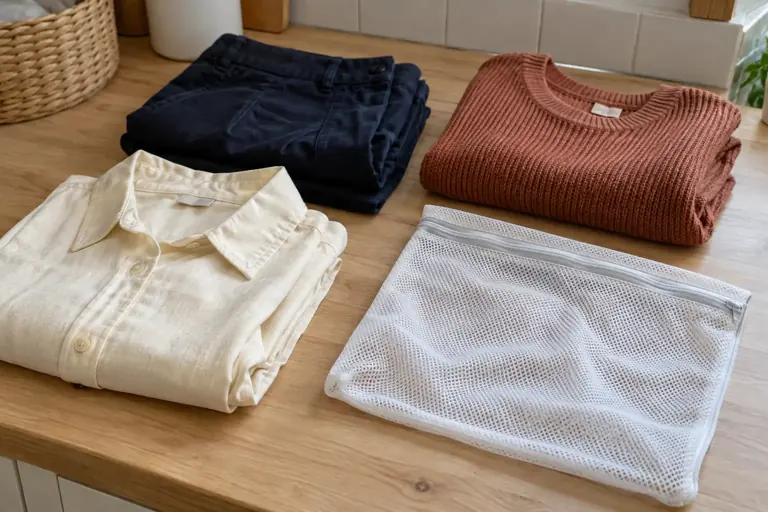
Look beyond the color of your clothes. An open zipper, buckle, or decorative detail can come into contact with a more delicate surface. Check the pockets, fastenings, and preparation instructions. A mesh bag may be part of a recommended method, but it doesn’t automatically make a garment suitable for any cycle.
Some items also shed more lint or easily pick up fibers from other fabrics. Notice which pairings make laundry care trickier and adjust your loads accordingly. You don’t need to create a permanent load for every little detail; just make a call when you’re putting a load together. A quick check on your sorting surface can keep you from discovering the problem only when the laundry is dry and ready to put away.
Sort as you go
The quickest sorting happens as soon as you take off a garment. A dark item, something that needs hand washing, or a piece with a stain goes straight to the right spot instead of sitting at the bottom of the hamper until laundry day. To make this feel natural, keep each spot in the same place and explain the system to everyone at home. Then the week’s load comes together without sorting everything at once.
Choose a setup that fits your available space
In a small home, two main hampers and a spot for exceptions may be more practical than a six-compartment sorter. The key is knowing what each spot is for. Use simple categories, then sort more carefully before washing. A hamper doesn’t automatically mean everything in it can be washed together.
If you share your home, make the labels clear to everyone. Choose labels that describe an action or a limit instead of a code only one person knows. For a particular item, a photo of the care label or a short note can prevent a mix-up. Keep the original instructions available, though: a handy summary helps you stay organized, but shouldn’t erase an important restriction on the garment or the cycle you use.
Keep damp items separate until you can take care of them
Don’t pack a wet garment into a closed hamper while you wait for a full load. Choose a setup that suits its condition and the garment’s care instructions. Sorting should make it easy to spot what needs prompt attention, without automatically mixing those items with dry clothes that can wait longer.
This question becomes especially useful when you get back from a trip, after an activity, or when a garment gets a liquid stain. Tell apart a short wait, possible drying according to the care instructions, and the care it needs. If you notice an unusual odor or persistent marks, look for the cause instead of masking the problem. To identify a stain, the guide for remove a stain from clothing helps you choose a method before washing. A clean, accessible hamper makes it easier to keep track, but it won’t fix unsuitable storage or poor ventilation in your home on its own.
Prepare the cycle without overloading the load
Before starting the washer, check its capacity for the selected cycle in the manual. The capacity listed for a standard cycle may not apply in the same way to a wool or delicate cycle. Don’t add an incompatible item just to make the drum feel fuller.
Then choose the product and amount according to its instructions, the load, and the relevant settings for your setup. Keep track of what works for everyday clothes, but check again when you add a new item. The ADEME’s clothing care guide puts garment care in the context of an item’s lifespan; for your everyday sorting, the practical goal is a suitable load, prepared without unnecessary steps or improvised treatments.
Plan for different laundry loads
A single load can include items that need different drying methods. So plan how to separate them before starting: a flat surface, drying rack, suitable hangers, or another permitted method. Don’t assume everything from the same wash can go in the dryer together. Check the instructions for less familiar items. For drying clothes in an apartment, the guide to drying clothes in an apartment has the complete method.
Organize storage for clean laundry, too. A clearly separate temporary area for clean clothes keeps you from needlessly washing them again. In Vestly, find the combinations planned with your clothes and plan ahead for the items you’ll need on a particular day. Sorting then becomes a helpful way to prepare your outfits: you know what’s ready, what needs simple care, and what still needs a decision.
Quiz
Can these items go in the same load?
Two garments are white. Is that enough for them to share the same cycle?
See the answer
No, their care instructions and fabrics must also be compatible. Color alone doesn’t determine the right temperature or level of agitation.
An item needs professional care. Where should you put it?
See the answer
In a designated area with the next step identified. Keep it visible and separate from the household laundry routine.
Items shared the same wash. Do they necessarily share the same drying method?
See the answer
No, check the drying instructions for each item. Drying is a separate step with its own limits.
Check off
The load is ready
0 / 5
Sorting covers the whole process, from the laundry basket to putting away clean clothes.
Watch a practical example
A visual example from Tor from Organizing TV to compare with the steps in this guide.
Video in English
Frequently asked questions
How many baskets do you need to sort laundry well?
There’s no required number. Choose a setup that fits your space, with a place for exceptions and a careful check before every load.
Can you wash everything at a low temperature to keep things simple?
That doesn’t resolve every incompatibility. You still need to check the agitation, detergent, colors, finishes, and whether the garment can be washed.
Can mesh bags replace sorting?
No. They can be part of a suitable method, but they don’t make different care instructions compatible.
Do you need to separate whites and colors in the washing machine?
Sorting by color is still a useful precaution, especially for new or dark pieces, or those that have bled before. It isn’t enough on its own: a white piece and a colored piece may also need different cycles or temperatures. So check the care labels before washing them together.
Do you need to sort your laundry every day?
Not necessarily. Sorting as you go—putting each item in the right spot when you take it off—is often enough. The key is knowing where each type of item goes so laundry day sorting stays quick.