Contents
Check the jeans before folding
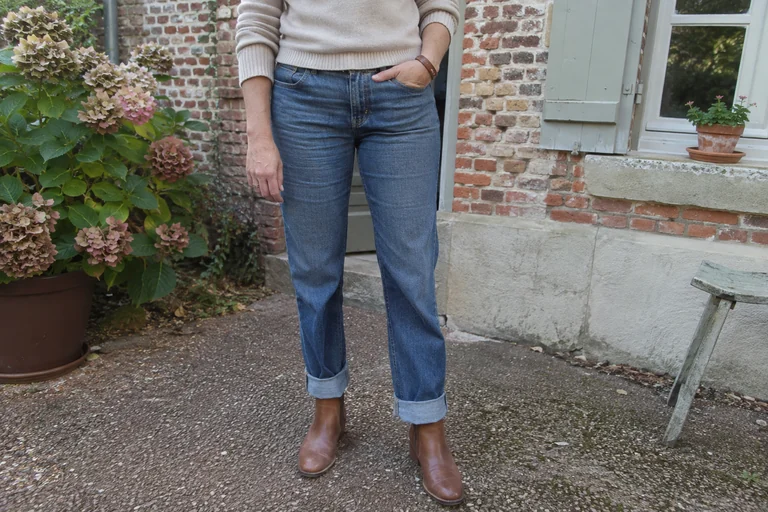
Wear the jeans at their usual waistband position. Do not pull the waistband higher just to make the hem appear shorter. Check front and side views with the shoes you plan to wear: where does the hem fall, does fabric rest on top of the foot, and does the edge touch the ground? These observations establish your starting point.
A cuff changes the visible hem, not the room around your hips or thighs. If sitting already feels restrictive, address the fit first. Our choosing jeans offers checks without requiring you to match a particular body shape. The same person can prefer different cuts for different uses.
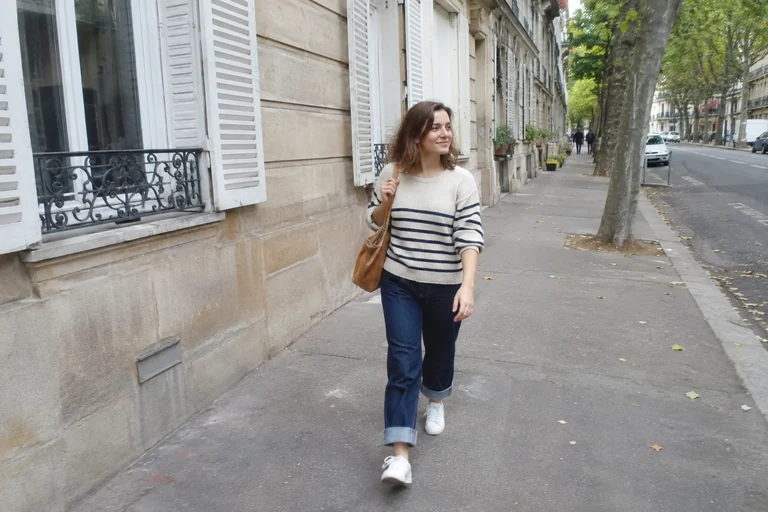
Make a single cuff
Fold the edge outward around the leg. Distribute the fabric with your fingers without stretching it hard. In this first version, the stitched hem remains visible within the cuff. Notice the contrast between the face and reverse of the denim: it can become an outfit detail even when your jeans have no colored selvedge edge.
Start with a modest fold and adjust it to your preference. There is no required measurement for every pair of jeans and shoes. A wide cuff exposes more of the reverse fabric; that does not automatically make an outfit better. Repeat on the other leg, then compare while standing on a level surface rather than lifting each leg in turn.
Try a double cuff without piling on folds
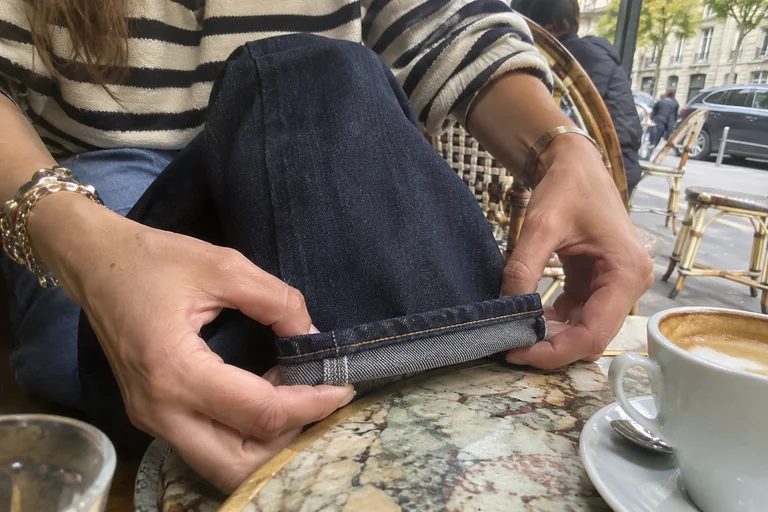
From the first fold, turn the fabric outward once more to hide the stitched hem. Smooth it around the leg and pay particular attention to the side seams, where layers overlap. A double cuff can create a cleaner-looking edge, but it may not suit thick denim or an already narrow leg opening.
If you need several turns to reach the desired length, undo them and reconsider. A bulky roll is not a requirement for wearing those jeans. Keep their length, choose another pair for those shoes, or seek alteration advice. An iron-on hem tape uses a different kind of fastening; it is not equivalent to simply unfolding a cuff.
| Option | What changes | What to check |
|---|---|---|
| Simple | Original hem remains visible | Evenness around the leg |
| Double | Hem hidden, extra layers | Bulk at the seams |
| Pinroll | Side fold narrows the opening | Ankle clearance and comfort |
Is a pinroll the same thing?
A pinroll adds a side fold before rolling the edge upward, so it also narrows the visible opening. It is not merely a taller cuff. If you try it, leave enough room to move your ankle and put the garment on without forcing it. A wide leg may bunch at the pinch point; a single cuff may be preferable.
The videos demonstrate techniques and personal style preferences. You can study a movement without adopting every shoe pairing or appearance claim. This comparison does not depend on slimming effects or a rule reserved for one body size. It concerns the fold in your garment and how you use it.
Video in English
Find your approach
Which detail do you want to adjust?
Choose an observation.
Choose the closest match: the corresponding guidance will appear here.
The cuff unfolds
Return to one fold
Undo the rolls and distribute one fold evenly. If it remains unstable, choose another setup instead of improvising a fastening.
The seam feels bulky
Compare the bulk
Compare one turned-up layer with two folds. Keep the option that does not get in the way against the shoe.
The shoe catches the cuff
Check movement
Walk and sit in the intended shoes. If the edge catches, undo the fold before changing one setting.
The legs look different
Start from the original hem
Unfold both legs, wear the waistband normally, and remake the folds before comparing on level ground.
The jeans have stretch
Avoid stretching the fold
Fold without pulling hard on the fabric. Check comfort in these jeans instead of relying only on the elastane percentage.
You are preparing for care
Unfold and inspect
Open the cuff to inspect it, then follow the complete garment’s label before washing or ironing.
 Read alsoHow to put together a harmonious outfit with what you have
Compare with your shoes while moving
Keep the same shoes for the first comparisons. An ankle-boot shaft and a low shoe leave different amounts of space for fabric. Look at the hem from the front, back, and side, then take a few ordinary steps. Sit down and stand again. The cuff may rise or meet the shoe differently; those are useful observations, not evidence of a wrong body shape.
Then change one variable: the number of folds, their height, or the shoes. A photo taken in the same place helps compare appearance. It cannot show whether the cuff tightens, rubs, or unfolds hours later. Our trouser length and shoes guide also separates apparent length from actual clearance around the foot.
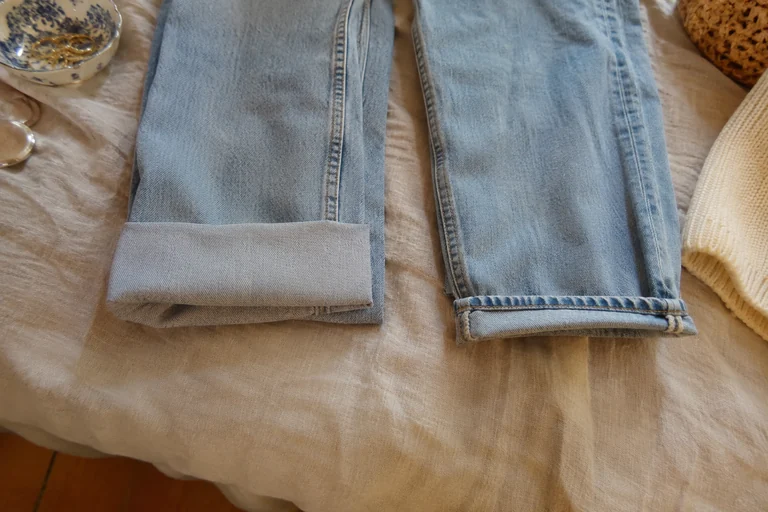
Unfold before deciding on care
After wearing, open the fold to inspect the hidden surfaces. Notice any mark or rubbing point before deciding what to do. Unfolding does not guarantee that every crease or mark disappears; fabric and previous wear matter. Our denim care guide starts with the garment’s needs instead of a required washing frequency.
With a new garment, finish fitting and read its instructions before first care. If it contains elastane, composition alone does not determine washing temperature or drying method. hand washing is not automatically allowed. Do not use heat or glue just to hold the setting from this fitting.
Quiz
Three practical checks
Does a double cuff add layers?
See the answer
Yes, check seam bulk. The folded fabric is still there.
Does a photo prove comfort?
See the answer
No, movement matters too. An image records appearance, not rubbing.
What should you compare first?
See the answer
One change with the same shoes. One variable makes the effect easier to assess.
Your Vestly wardrobe helps you find the pieces you used and plan another fitting. Keep comparison photos and movement observations separately when needed: a digital representation guarantees neither comfort nor cuff stability. This method uses your current clothes and requires no accessory purchase.
Check off
Before keeping this cuff
0 / 5
All five checks are complete; keep useful observations.
Frequently asked questions
How many inches should I fold?
No measurement suits every pair. Start with a modest fold, then compare bulk, visible length, and movement with your shoes.
Can I cuff wide-leg jeans?
Yes, if you like the result. Check seam bulk and contact with the shoe; a pinroll is optional.
Does a double cuff always hold better?
No. It depends on the garment and movement. Compare instead of adding folds when the fabric becomes uncomfortable.
Must I iron the cuff?
This fitting requires no ironing. Check the complete garment’s instructions before applying heat; do not force a crease to copy a photo.
Is a pinroll a sewn hem?
No. It adds a side fold and turns of fabric. A sewn or glued alteration uses a different fastening.
Can I leave the cuff folded for washing?
Open it to inspect hidden surfaces, then follow your garment’s washing instructions. The fold determines neither the cycle nor the product.
Sources and scope
- GQ — cuffing, rolling and stacking.
- GQ México — cómo doblar los jeans.
- jeans.info — le revers comme alternative.
Guides read November 12, 2026. Techniques and style preferences, with no universal measurement or physical garment test by our team.