Contents
- Does your poncho pull over your head or stay open?
- Where would you like the lengths to meet?
- What should you wear under your poncho?
- Which outfits can you try without buying anything?
- Can you move comfortably in the outfit?
- How can you choose colours without adding more accessories?
- What can a virtual try-on in Vestly show?
- What should you look for in a construction demonstration?
- How should you store and care for your chosen garment?
- Frequently asked questions
- Sources
To wear a poncho, first check how it is made and where its edges fall. Try it over two base outfits you enjoy, then compare colours, lengths and movement. A belt or slim trousers may appeal to you; neither is compulsory. The outfit should also work when you sit down, carry your bag or remove the outer layer.
You like your poncho on its hanger, yet it goes back into the wardrobe whenever you try to make an outfit. Your trousers feel too prominent, the bag slips or the shirt disappears beneath the knit. Start with clothes you already have: a familiar base, then the poncho, then one adjustment. You do not need to find an ideal silhouette before discovering what works for you.
Does your poncho pull over your head or stay open?
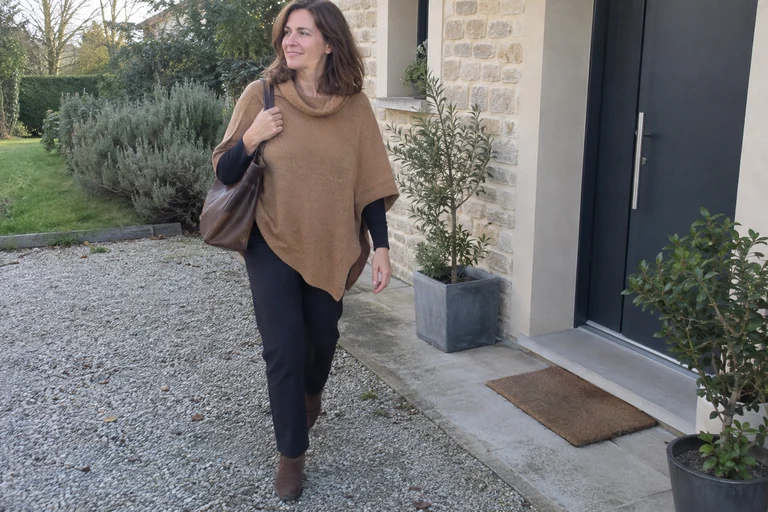
Lay the garment flat before wearing it. Some shapes pull over the head through a central opening; others stay open at the front and resemble a shawl. Some have buttons, slits or short seams that guide the arms. These details affect positioning, carrying a bag and closing the garment. The product name does not always describe its full construction.
Find the front indicated by the maker, if there is one. A longer point does not universally belong at the back. Check the neckline, fastenings and intended orientation rather than stretching an opening to copy a photograph. For an open garment, compare loose panels with a fastening designed for it. If you keep pulling at an edge, reconsider its position or the outfit underneath.
Flip cards
Three constructions, three checks
Central openingFlip
Check the head opening and where the edges sit without pulling the neckline.
Two front panelsFlip
Check how the garment stays in place with your bag and movements.
Buttons or slitsFlip
Use the intended openings rather than forcing a position seen elsewhere.
Where would you like the lengths to meet?
Put the poncho over a simple base and look at the front, sides and back. Its edge may be straight, curved, pointed or asymmetric. A shirt may show at the sides while remaining hidden at the front. Decide whether you enjoy that shape instead of applying a length supposedly suited to every body. Keeping the same shoes makes it easier to recognise your preference.
If a shirt hem shows in a way you dislike, try a clearer length difference or a shorter base. Make one change and look again. You are arranging garment lines, not correcting your body. Our guide to layering clothes and their lengths explores these meeting points with other layers.
What should you wear under your poncho?
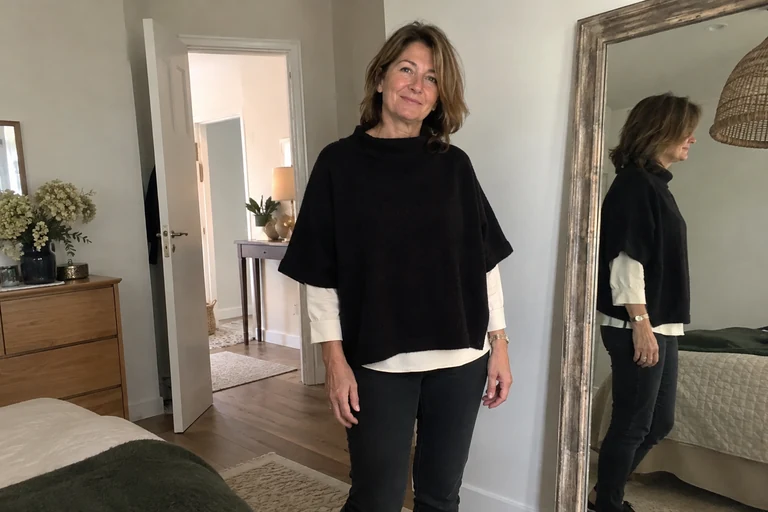
Start with a top you already feel comfortable wearing. Flexible sleeves may help with layering; a more prominent collar may also appeal if the neckline leaves room. Check folds and rubbing points. A thin garment is not automatically more comfortable, and no fabric is compulsory here. Keep a base you will enjoy wearing after taking the poncho off.
For the lower half, compare two options from your wardrobe. Straight trousers give a simple first view of the volume; wide trousers can still be a deliberate preference. Look at the hem width, visible shoe and comfort when seated. Our casual chic style helps clarify the occasion without making one cut a requirement for looking stylish.
A dress or skirt offers another base. Check the lengths while walking and sitting rather than trying to hide the entire garment under the poncho. With a midi skirt, wear your intended shoes during the fitting: they affect how you see the lower part of the outfit. Our midi skirts and shoes lets you compare that detail separately if needed.
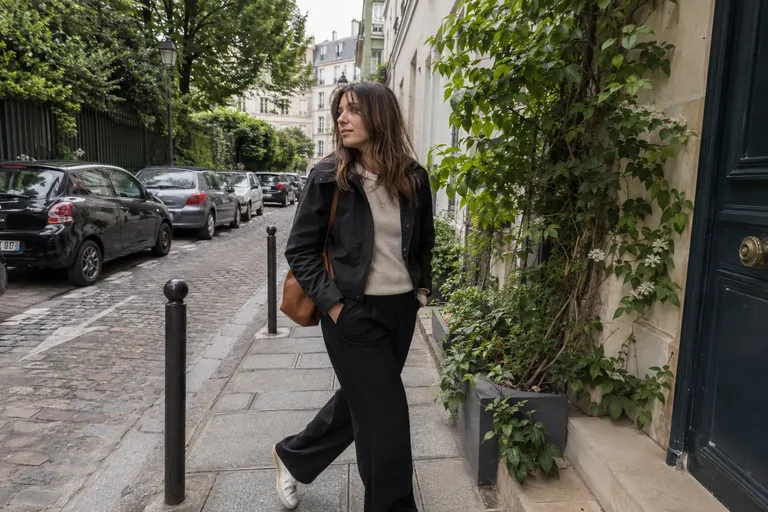 Read alsoHow to put together a harmonious outfit with what you have
Which outfits can you try without buying anything?
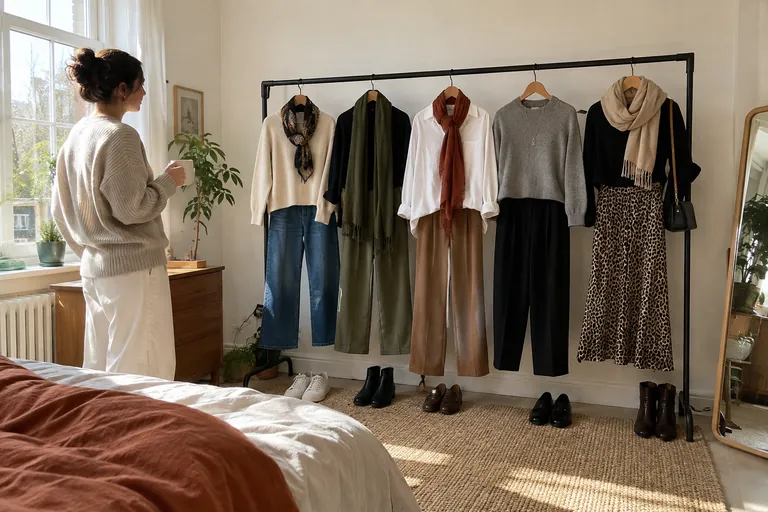
The six suggestions below are starting points, not outfits to copy item by item. Choose a context close to your day, then use the next option to compare a second base. Each idea includes a detail to check. You can read all suggestions directly; this activity requires no account or photograph. Your own wardrobe remains the first place to look.
Outfit ideas
Six outfit ideas by context
Plain poncho, flexible top, straight jeans and shoes already comfortable for you: check your bag position and how the edge moves with your stride.
See all ideas
Walking in town
- Plain poncho, flexible top, straight jeans and shoes already comfortable for you: check your bag position and how the edge moves with your stride.
- Short poncho, visible shirt and wide trousers: compare the volume with the same shoes without trying to make your silhouette smaller.
Work
- Poncho over a shirt-and-trousers base you would wear alone: sit down and remove the outer layer to check both versions of the outfit.
- Understated poncho and simple dress: check the dress hem when seated, then whether your arms have room at your workspace.
A relaxed outing
- Patterned poncho over a plain base: choose one repeated colour and leave everything else unchanged for this first fitting.
- Plain poncho and midi skirt: compare a shorter and longer outer edge with the shoes you actually plan to wear.
Can you move comfortably in the outfit?
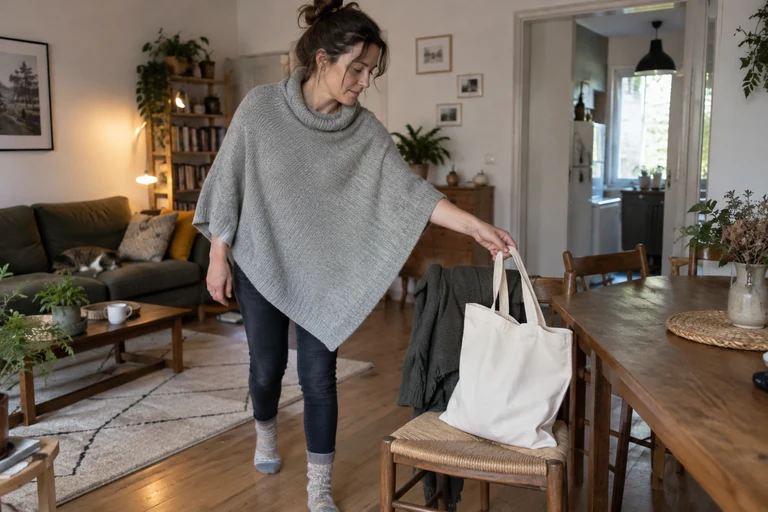
Before deciding, try a few everyday movements: sit down, reach for an accessible object and pick up your bag without twisting awkwardly. Notice whether the poncho rides up, slips or gets in the way of your hands. A pleasing photograph does not check these details. If you keep holding the knit in place, change the bag position, base or outer garment rather than keeping still.
A belt can change the shape of a flexible garment, but it does not suit every construction. Check that your arms remain free and the panels do not pull when you sit. Do not tighten it to recreate a waistline in a photograph. An unbelted version is still a complete outfit. Our guide to choosing a belt for an outfit helps compare that detail without making an accessory compulsory.
How can you choose colours without adding more accessories?
With a patterned poncho, first look at the colours visible while wearing it. A pattern spread flat may show different shades from those near your face. You might repeat one colour in your trousers, top or an accessory you already own. A deliberate contrast is also an option. You do not need to repeat every colour in the pattern throughout the rest of your outfit.
For a plain poncho, compare a base close to its colour with a more contrasting one. Keep the same shapes to understand how colour changes your preference. Our guides to pair colors and building a tonal outfit offer further comparisons. They suggest styling options, not a ranking of bodies or tastes.
Look at the visible collar and sleeves too. A thick scarf, high neckline and bulky knit may feel pleasant or take up more space than you want together. Try removing one detail before changing the whole outfit. For folding and positioning a square scarf, our guide to wearing a scarf without adding excess bulk lets you work on that accessory separately.
Your day may include several places. An outfit that feels pleasant at home may need a different arrangement when you carry a bag or keep the poncho on your lap. Plan somewhere to put the garment when you remove it instead of rolling it onto a wet surface. This small detail helps you choose beyond the first photograph while keeping your base outfit useful indoors.
If you add a coat, check the actual layers around your shoulders and arms. Knitwear may take up more room than a thin top even when it looks flexible. Try both layers together before choosing them for the day. If the combination pulls or keeps riding up, try another jacket or a simpler base; your poncho does not have to fit under every coat.
Compare your bag with its usual contents rather than adding extra weight for the fitting. A shoulder handle and a crossbody strap do not move the panels in the same way. Try how you actually carry it, then check whether you can open the bag without holding the poncho with your other hand. Your choice may change with the activity; no bag style is ideal in every situation.
To keep an outfit idea reusable, note what you decided against as well. For example: “I like how the shirt hem shows, but this bag handle slips on the knit.” That observation describes one combination; it does not rule out the poncho or every shirt. Next time you can keep the successful elements and check only the troublesome detail instead of starting the entire fitting again.
What can a virtual try-on in Vestly show?
Vestly lets you save clothes in a digital wardrobe and generate an outfit preview on your photographs. You can prepare two combinations using available pieces and compare their visual appeal. The preview does not measure movement allowance, warmth, actual fit or fabric behaviour. Keep a physical fitting for movement, openings and how the clothes feel.
A combination you like can become a reference for the week: note the actual base, shoes and bag. You will then find a complete outfit rather than an isolated poncho in your inventory. Our guide to plan your outfits for the week keeps this organisation simple. A few available combinations are enough; you do not need to buy missing pieces to validate an idea.
What should you look for in a construction demonstration?
A visual example from Petite Dressing to compare with the steps in this guide.
Video in English
Quiz
Three checks before choosing your outfit
Are wide trousers ruled out with a poncho?
See the answer
No, compare the outfit and your comfort. Check your preferred volume on the clothes you are wearing; it is not a body-shape rule.
Does a virtual preview check freedom of arm movement?
See the answer
No, keep a physical fitting. The image helps compare appearance; check movements and sensations while actually wearing the outfit.
Is the word poncho enough to choose how to wash it?
See the answer
No, read the garment’s care label. Composition and construction vary; instructions for another design do not automatically apply.
How should you store and care for your chosen garment?
Read the actual garment’s label. As an example checked in October 2026, UNIQLO 480278 lists polyester, wool and viscose with no washing and dry cleaning. Neither the word poncho nor wool content is enough to choose a wash cycle. This commercial example illustrates a limit, not a purchase recommendation.
For washable wool garments, Woolmark recommends flat drying knitwear while following the item’s own care instructions. Do not apply this advice to a garment whose label rules out washing. Our guide to washing wool and cashmere explores care questions. Store the dry garment without unnecessarily stretching its shape and keep the care instructions accessible.
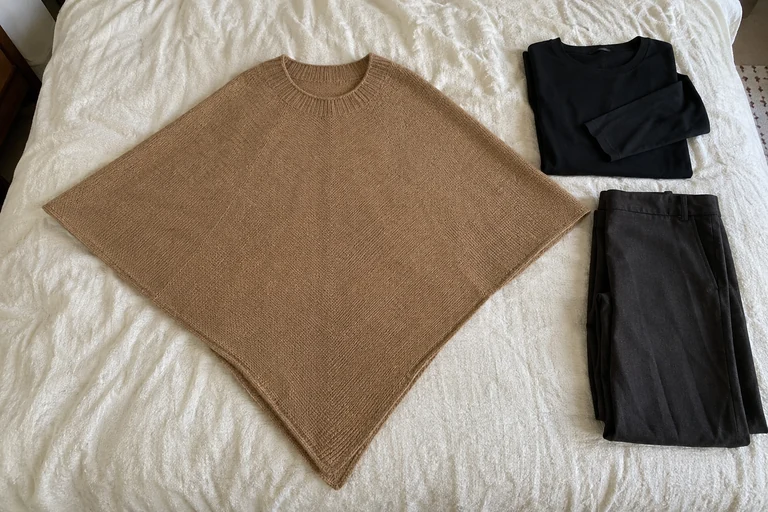
If the poncho remains difficult to wear after several fittings, note the exact issue: an awkward opening, a length you dislike or a combination unsuited to your days. That information can help with alterations discussed with a professional, another use or a wardrobe review. A garment you enjoy in a photograph does not have to remain a daily burden in your wardrobe.
Check off
Is your outfit ready for a real day?
0 / 6
All six points are checked: keep the useful observations, without assuming comfort in every situation.
Frequently asked questions
Which trousers can you wear with a poncho?
Compare straight trousers with another cut you already own, using the same shoes. Slim trousers may appeal, but wide ones are not ruled out. Look at your preferred volume and comfort during everyday movements.
Does a poncho need a belt?
No. A belt can change the shape if the construction allows it without restricting the arms or pulling the panels. A loose version is still complete. Do not tighten it to recreate a photographed silhouette.
Can you wear a poncho if you are short?
You can compare lengths and volumes you enjoy without a height-based restriction. Look at the actual edge at the front, sides and back. Movement and comfort matter alongside how you feel about the silhouette.
Does a knitted poncho replace a rain jacket?
Its name and volume do not prove waterproofing. Check the actual garment’s stated features and adapt your outfit to expected conditions. This guide covers styling combinations without promising weather protection.
Can Vestly check a poncho’s fit?
The generated preview can help compare a visual idea using your clothes. It does not measure size, movement allowance or fabric feel. Keep a real fitting to check openings, movement and contact with other garments.